About Diloma concameratum (W.Wood, 1828)
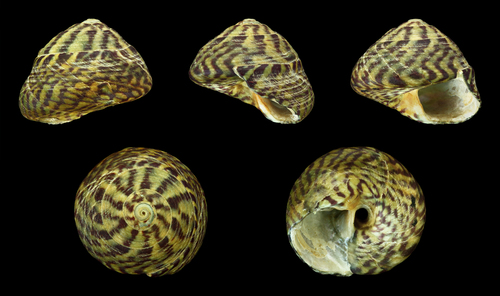
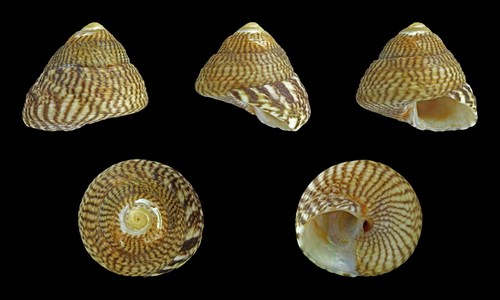
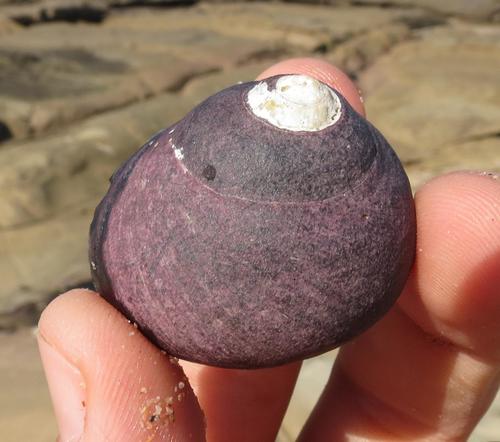
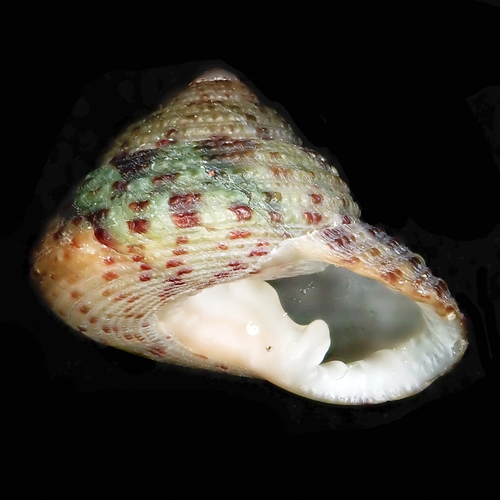
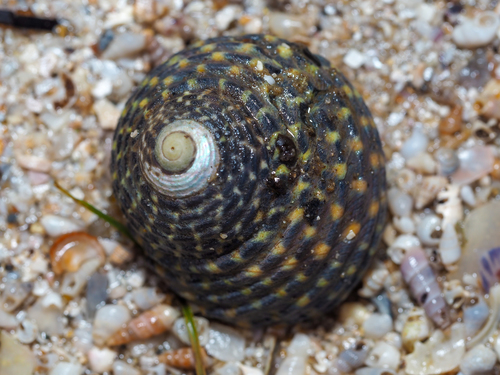
Diloma concameratum (W.Wood, 1828) has a shell with a height ranging between 15 mm and 27 mm, and a diameter between 23 mm and 25 mm. The shell is very thick, solid, imperforate, shaped like a globose cone, and is generally rather depressed. Its color is yellow and black, arranged in a tessellated pattern or as longitudinal stripes; sometimes black is the dominant color, and other times yellow is dominant. The spire is a very short cone. The apex is usually perfect and acute, and often has a ruddy color. The five slightly convex whorls increase in size very rapidly. They are marked with strong spiral ridges, with 13 or 14 ridges on the last whorl. The body whorl descends slightly at the aperture, and is not eroded on the base. The large aperture is oblique. The outer lip is edged inside with yellow and black; after this band, there is a nacreous layer, followed by an opaque white thickening that contracts the aperture to a varying degree, and is more or less notched around the area of the periphery. The columella is white, and much narrower than that of Diloma aethiops. It has two small teeth at the lower end. The most prominent identifying traits of this species are its strong spiral ribs, and its thick outer layer of yellow and purplish-black, or black veined with yellow that usually forms a tessellated pattern. Sometimes, black can become so dominant that almost no yellow is visible, and there are also specimens where black is barely visible on the surface. This is a marine species that is endemic to Australia, and can be found off the coasts of New South Wales, South Australia, Tasmania, Victoria, and Western Australia.