About Dillenia alata (R.Br. ex DC.) Martelli
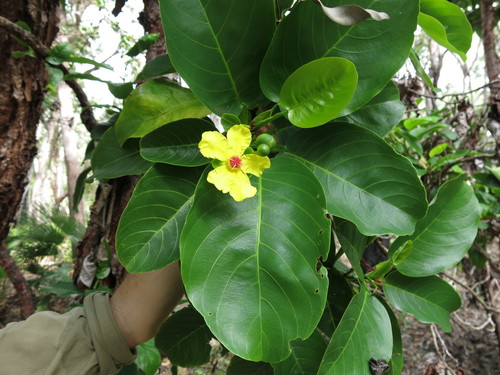
Dillenia alata is a medium-sized tree that reaches 20 m (66 ft) in height, with a trunk up to 60 cm (24 in) in diameter and a dense, shady crown. It has distinctive reddish brown, papery bark that peels easily. Its leaves are simple and entire, meaning the leaf blade has no marginal teeth, lobes, or other divisions. Leaves are glossy dark green, relatively large, growing up to 25 cm (9.8 in) long and 12 cm (4.7 in) wide, with between 8 and 14 lateral veins on either side of the midrib. They are arranged spirally on twigs, borne on petioles (leaf stalks) about 4 cm (1.6 in) long. The petioles are broadly and noticeably winged, and they sheath the twig.
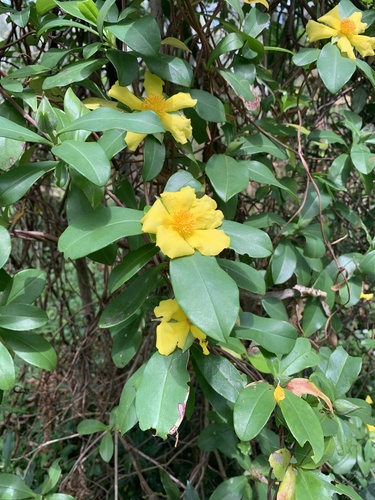
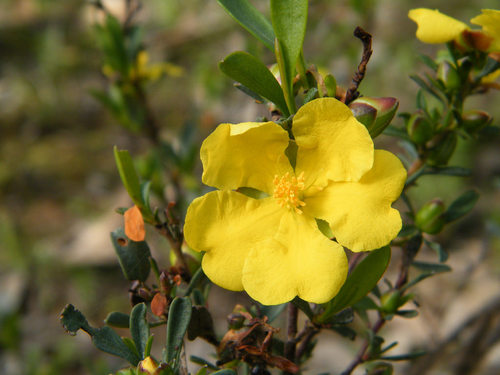
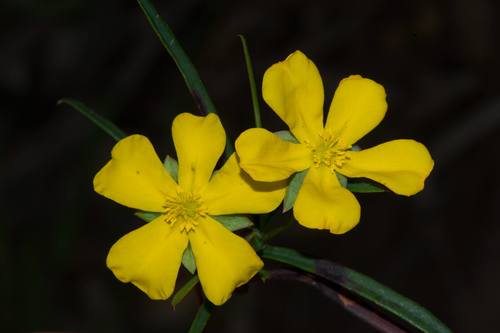
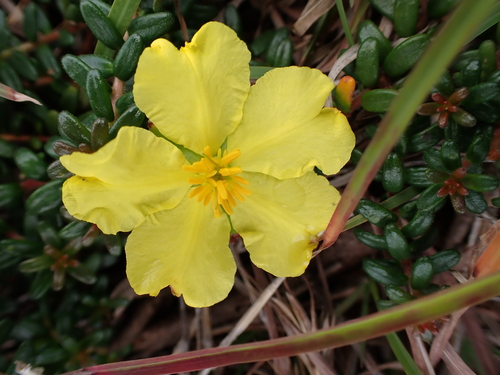
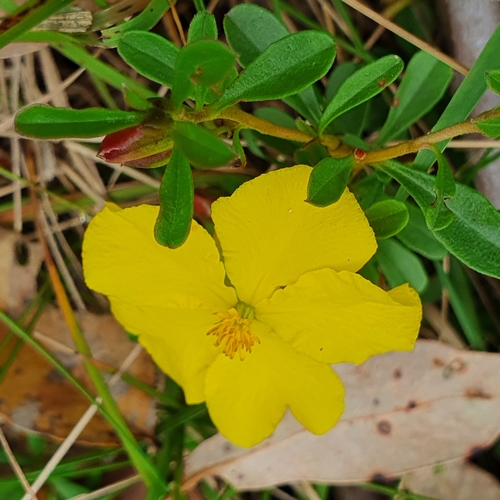
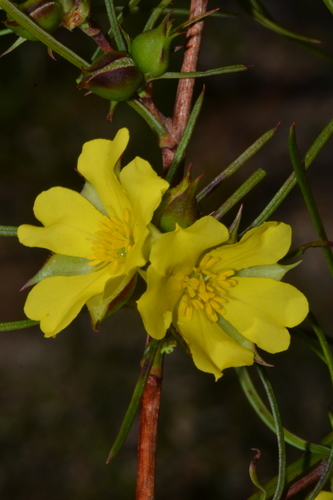
The inflorescence is a raceme holding up to 4 flowers, borne on twigs roughly opposite a leaf. Each flower is held on a pedicel about 4 cm (1.6 in) long. The green calyx has five lobes arranged in two whorls: the inner whorl has three lobes about 20 mm (0.8 in) long, while the outer whorl has two lobes up to 13 mm (0.5 in) long. There are five (sometimes six) yellow, rounded petals about 4 cm (1.6 in) long and 2.5 cm (1 in) wide.
At the centre of the flower are two whorls of stamens: the outer yellow stamens are shorter, number around 100, while the inner stamens are taller, pink-red, and number around 20. There are 6–8 carpels arranged around the receptacle, with pink-red styles up to 12 mm (0.5 in) long; each carpel contains 8–10 ovaries.
The distinctive fruit is a dehiscent red capsule with a persistent calyx. It opens widely at maturity, splitting into 8 valves (segments), and reveals multiple 4 mm (0.16 in) long black seeds that are fully enclosed in a waxy white aril.
This species is native to Waigeo island, New Guinea, the Torres Strait, and the Northern Territory and Queensland in Australia. Most observations in New Guinea come from the island's southernmost region, adjacent to the Torres Strait. In the Northern Territory, the species occurs mostly in northeast Arnhem Land, while in Queensland it grows from the Torres Strait islands south along the east coast of Cape York Peninsula to approximately Cardwell. It grows in rainforest, monsoon forest, and open woodland, and is most common in lowland forests in very wet locations such as coastal swamps and areas near watercourses. It occurs at altitudes from sea level up to around 600 m (2,000 ft).
Flowering has been observed year-round, with a peak from June to September and the lowest flowering activity around March. Flowers are likely pollinated by carpenter bees of the genus Xylocopa. Fruits are eaten by a number of birds, including the eclectus parrot (Eclectus polychloros). This tree also acts as a host for larvae of the Queensland moth Pollanisus commoni.
This species has considerable horticultural merit. Australian botanist David L. Jones wrote in his book Rainforest Plants of Australia that it is "a striking ornamental, common along stream banks and in swampy soils. The leaves, bark, flowers and fruit are all highly decorative features". In Cairns, Queensland, over 200 of these trees have been planted across the city by the Cairns Regional Council, mostly in parks and larger gardens.