About Digitalis minor L.
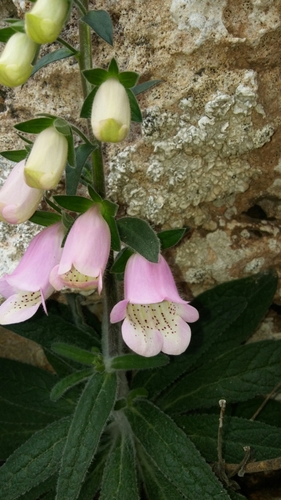
Digitalis minor L. is a biennial or short-lived perennial foxglove species with pink, pendulous flowers; uncommon white-flowered forms also exist. Plants are somewhat caespitose, often growing as a small cluster of densely packed leaf rosettes. The entire plant is usually covered in tomentose hair (trichome) indumentum, only some of which are glandular, though glabrous (hairless) plants are occasionally found. The plant base is woody, and either branches low to the ground or produces a single rosette. Each rosette grows an angular stem 10 to 80cm tall, which may be green or purplish. These stems have a dense indumentum of 0.4 to 0.7mm long non-glandular hairs and very short, subsessile glandular hairs, and are rarely glabrous. Stems bear few leaves along their length; most leaves are clustered at the plant base. Leaves are usually greyish-green, and leaves located partway up the stem are not decurrent. The lowest basal leaf blades are 3 to 10cm long and 1 to 4cm wide, elliptic to oval in shape, with a soft, non-coriaceous (non-leathery) texture. They are flat, or sometimes somewhat revolute, with a blunt (obtuse) apex, a subentire or crenulate margin, and taper towards an 8 to 40mm long petiole. The underside of the leaves has a very dense ash-grey indumentum, made up of both purplish, non-glandular 0.3 to 0.5mm long hairs and subsessile glandular hairs. In rare cases, leaves may be glabrescent with only glandular hairs, or completely glabrous. The inflorescence is 5 to 25cm long, exceptionally as short as 1.5cm or as long as 53cm. It is secundiflorous, meaning all flowers are arranged to one side of the inflorescence, and usually holds 5 to 20 flowers, exceptionally only 1 or up to 36. Individual plants are polymorphic, producing either few or many flowers. The peduncle has internodes 9 to 27mm long, and is covered in 0.4 to 0.7mm long non-glandular hairs and 0.3 to 0.4mm long subsessile glandular hairs. It bears lanceolate-shaped bracts at the nodes; these are 3 to 20mm long, 2 to 4mm broad, and have the same hair covering as the rest of the plant. Flowers have a 4 to 21mm long, more-or-less straight pedicel that may be shorter than, equal to, or longer than the bracts. The calyx has unequal sepals that are pubescent and more-or-less appressed to the corolla. Lateral sepals are 8 to 16mm long, 2 to 4mm broad, elliptic or lanceolate, with sharp apexes. The top sepal is shorter and more elongated than the other sepals. The corolla is 28 to 35mm long, sub-bilobed, bell-shaped, pink to pinkish-purple (exceptionally white), and hairy on its outer surface. The corolla tube is 20 to 30mm long and 14 to 23mm wide, one to two times longer than it is wide, and gradually tapers towards its base. The front interior of the tube has dark-purple dots 1 to 1.5mm across; these dots are surrounded by white halos that fuse together to form a large white patch. The tube mouth is usually ciliated. The upper lip is either entire or bilobed. The lower lip has well-developed, auricular (ear-like) lateral lobes that are clearly cleft all the way to the tube mouth. The central lobe is 6 to 13mm long. The ovary is covered in glandular pubescence; the style has a variable hair covering, and is sometimes glabrous. The fruit is a capsule 10 to 15mm long and 6 to 10mm broad, ovoid or nearly spherical in shape, distinctly much shorter than the calyx, and covered in glandular pubescence. The chestnut brown seeds are 0.5 to 0.7mm long, 0.3 to 0.5mm wide, and sub-cylindrical to obconical in shape. Digitalis minor is endemic to the eastern Balearic Islands, where it occurs on Majorca, Menorca and Cabrera. Its geographic distribution is explained by the complex geological history of the Mediterranean region. At the end of the Oligocene and beginning of the Miocene, pressure from the African continent against the Iberian microplate uplifted the mountains of the Baetic System, creating a long peninsula extending east into the Mediterranean Sea. This may have formed a land bridge connecting all the way to Corsica and Sardinia, which were a single land mass at the time that later rotated left, with Menorca breaking off at the end of the Oligocene. During the late Burdigalian and Langhian stages of the Miocene, the Balearic Islands existed as two large islands, and sometimes connected to the Andalusian mainland over subsequent millions of years. During the Messinian stage, the Mediterranean Sea's connection to the Atlantic Ocean closed, and the entire sea evaporated over the course of a million years, leaving a kilometre-thick layer of salt and a vast salt marsh that the Nile drained into. Corsica and the Balearic Islands became connected again, allowing species migration. In the Pliocene, the islands separated from the mainland again as a single large island, and broke up into two large eastern and western islands during the Pleistocene. The eastern island split to form Menorca and Majorca during the Würm glaciation, and had split a number of times before this. This geological history explains the shared distribution of certain plant species across different Mediterranean islands, with species moving to the Balearic Islands from either the east or west depending on the epoch. According to Contandriopoulos and Cardona, D. minor is an example of migration from the west; its ancestor is Digitalis purpurea subsp. purpurea, which moved into the region from Spain, and the original ancestor taxon was later extirpated from the western Balearic islands. Petra-Andrea Hinz Alcaraz states this invasion occurred sometime before the Messinian stage. This makes D. minor a 'schizoendemic': an endemic that evolved from a neighbouring population after becoming isolated from it, via the speciation process known as vicariance. The genetic structure of modern populations supports the theory that D. minor existed as a single population on a large combined island relatively recently. Modern genetic structure, specifically the relatively high genetic diversity within populations compared to between populations, also indicates the species has never been particularly rare, with little evidence of historical population or subpopulation bottlenecks. In its native environment, D. minor flowers in May and June, and exceptionally in April or July. It is a protandrous plant, meaning the male reproductive parts of the flower mature before the female parts. There is substantial evidence of high gene flow between individual plants. It grows in rocky habitats, including rock cracks, fissures and cliffs, wet rocks, in both sunny and shaded spots, and also occurs on seaside cliffs. Populations grow among calciferous rocks, and D. minor is one of the few foxglove species that prefers such alkaline soils. It is very rarely found growing in siliceous soils. It occurs from sea level up to 1,400 metres in altitude. It grows in association with many endemic or characteristic Balearic plant species: Arabis verna, Arum pictum, Brassica balearicum, Cerastium luridum, Clypeola jonthlaspi, Crepis triasii, Delphinium pictum, Globularia majoricensis, Helichrysum lamarcki, Laserpitium gallicum, Linaria aequitriloba, L. aeruginosa, Rhamnus oleoides, Rumex intermedius, Scabiosa cretica, Sesleria coerulans subsp. insularis and Sibthorpia africana. In experimental research, a gene from Arabidopsis thaliana has been inserted into the genome of Digitalis minor to create transgenic plants. This experiment was conducted to test if the production of cardiac glycosides could be increased, since other Digitalis species remain the main industrial source of these medicinal compounds. The metabolic engineering experiment was successful: expression of the inserted gene led to increased sterol and cardenolide production in the resulting transgenic plants.