About Dietes bicolor (Steud.) Sweet ex Klatt
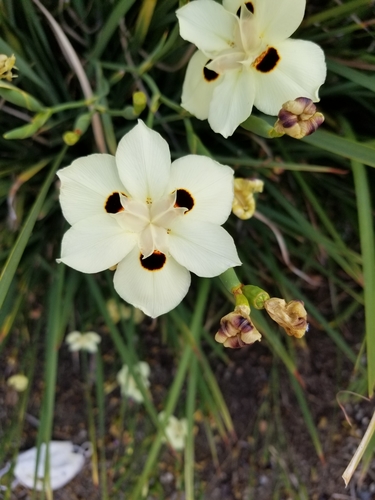
Dietes bicolor, commonly known as the African iris, butterfly flag, fortnight lily, or peacock flower, is a clump-forming rhizomatous evergreen perennial plant in the iris family Iridaceae. It produces long, sword-like pale green leaves that grow from multiple fans at the base of the clump. If left undisturbed for years, this plant can form large clumps. It is commonly cultivated in its native South Africa, where it is often used in public gardens, for beautifying commercial properties, and along roadsides. It is also cultivated in other mild temperate regions around the world. Its blooms appear in spring and summer, and are pale yellow with three dark purple spots that may be so dark they look black. Each dark spot is surrounded by an orange outline. After blooming, the plant produces a seed capsule that can bend the flower stalks down to the ground. When the capsule dries and splits, it disperses the ripe dark brown seeds inside. The leaves of Dietes bicolor are narrower than the leaves of Dietes grandiflora and Dietes iridioides, and they tend to arch more. For cultivation, these plants grow best in dappled shade to full sun, where they will flower in profusion. They can also grow in shaded areas, though this leads to reduced flower production. This species, along with Dietes grandiflora, is very drought tolerant.