About Diervilla lonicera Mill.
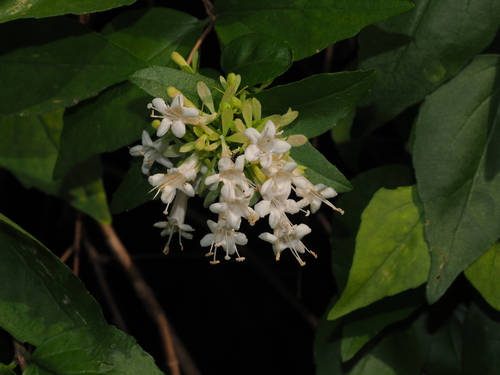
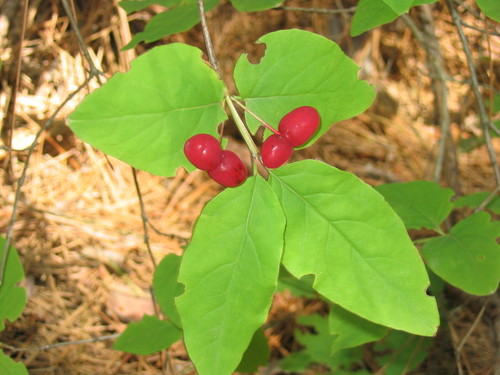
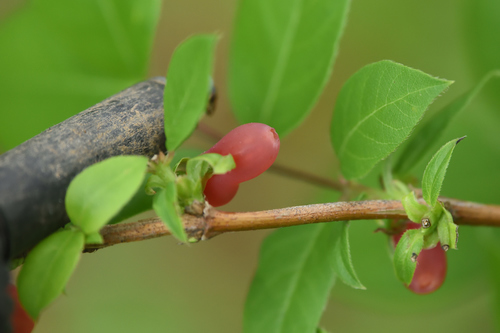
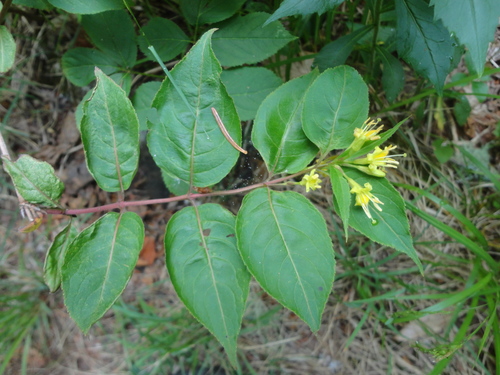
Diervilla lonicera Mill., commonly called northern bush honeysuckle, is a deciduous shrub that grows to a maximum height between 0.6 and 1.2 metres (24 and 47 inches). This species has several distinct characteristics: branches that lie close to the ground, fibrous roots, pale yellow flowers, and dry, woody fruit. Its simple leaves grow in an opposite arrangement on stems. Leaf colour changes with the seasons: starting green, the leaves gradually deepen to dark red. Flowers are fully in bloom between early July and early August. Woody seeds reach full maturity by September, ready for dispersal. The flowers of Diervilla lonicera are protogynous, meaning they are initially female-dominant. This species is well-adapted for pollination, and its stigmas remain receptive after anthesis, when the flower is fully developed and functional. A typical habitat for Diervilla lonicera consists of exposed rocky sites, and the plant tolerates cool climates, dry soils, and infertile soils. It is commonly found in forests dominated by balsam fir (Abies balsamea) and jack pine (Pinus banksiana). Unlike many plant species that are limited to specific light conditions, northern bush honeysuckle is insensitive to light changes, which lets it occupy a broader range of habitats. It is also well-adapted to fire-prone habitats, because it can regenerate quickly from underground stems if aboveground growth is destroyed by fire. For example, researcher D.J. Schoen found that Diervilla lonicera was the most abundant shrub over a 50-year span on dry ground areas destroyed by fire. Northern bush honeysuckle is widely distributed across most of North America. It grows along the entire east coast of the continent, ranging from Northern Quebec and Labrador in the north down to Georgia and Alabama in the south, and stretches west as far as Saskatchewan. It was also introduced to parts of Europe in the eighteenth century, though the exact year of introduction is unknown.