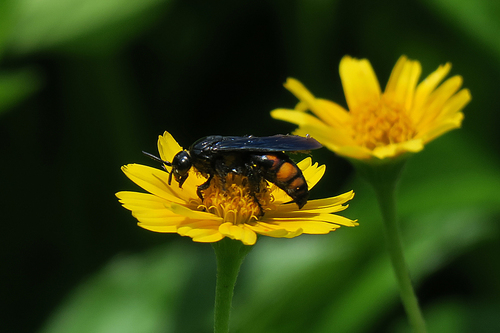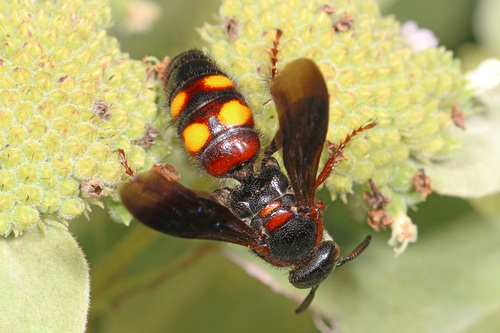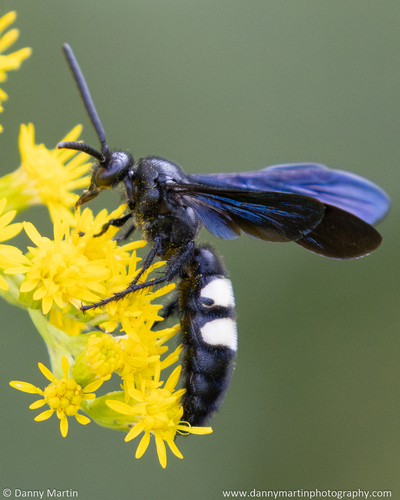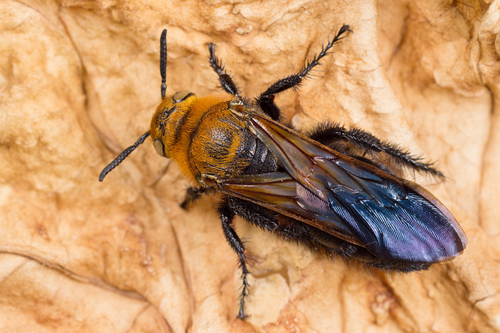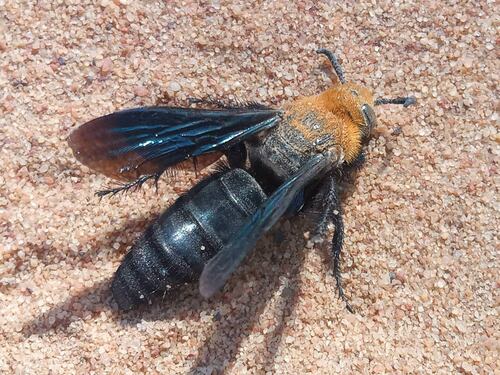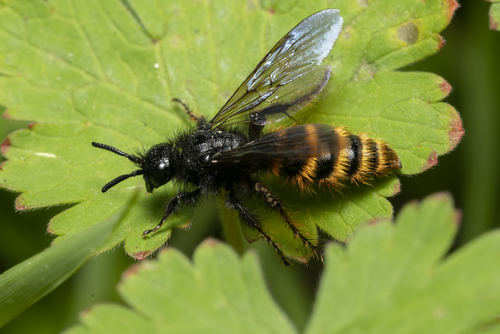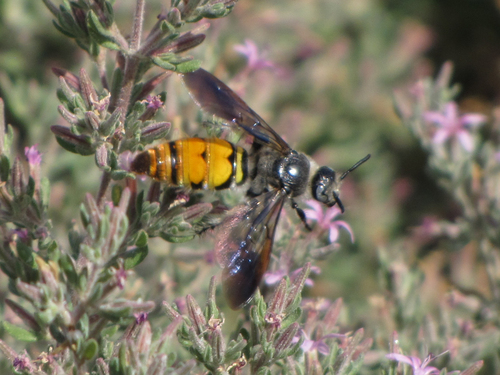
About Dielis tolteca Saussure, 1857
Description and identification: For female Dielis tolteca, extensive orange markings cover at least three gaster tergites. The orange marking on the first gaster segment varies widely, ranging from a complete orange band to no orange band at all, and every intermediate form in between. The closest related species to D. tolteca with orange markings is D. dorsata, in which orange markings are restricted to only the second and third gaster tergites. Male D. tolteca have four pale yellow bands on both the tergites and sternites of the gaster, plus a yellow band on the pronotum. For males, the most similar species is again D. dorsata, which has sparser setae on the external valve of the penis and lacks banding on its sternites. Male D. tolteca share paler body markings with another related species, D. plumipes. D. plumipes is sympatric with D. tolteca in Texas, and has entirely black clypeus and pronotum. Another related species, D. pilipes, has a fifth abdominal band, a trait only shared with D. tejensis. D. pilipes is structurally distinct from all other members of the Dielis genus due to its unique microstructuring on the frons, propodeum, mesonotum, and hind tibiae. Distribution: D. tolteca occurs mainly in the Southwestern United States and Mexico, and is also found in Haiti.