About Didymocheton fraserianus (A.Juss.) Mabb. & Hauenschild
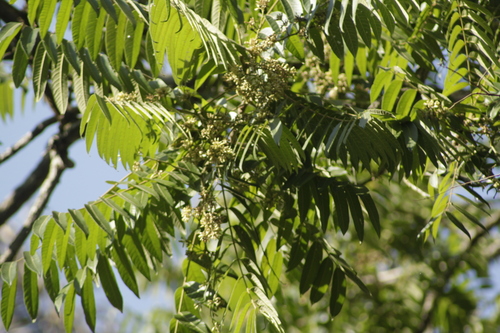
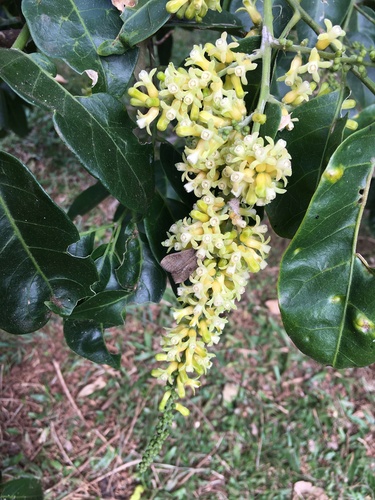
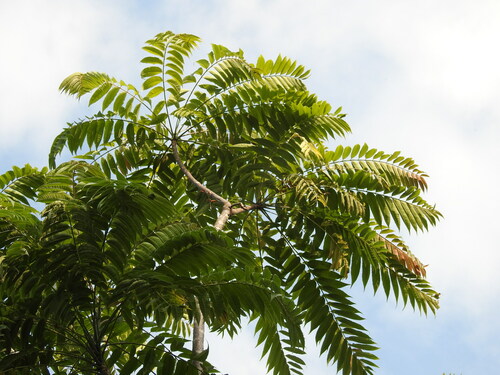
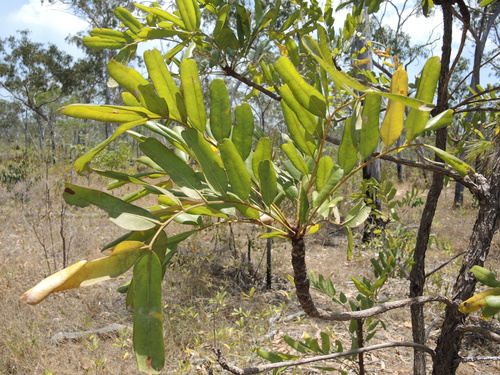
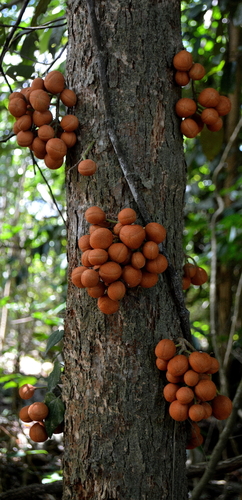
Didymocheton fraserianus (A.Juss.) Mabb. & Hauenschild is an evergreen tree that typically grows to 30 m (98 ft) tall, with a trunk up to 1.2 m (3 ft 11 in) in diameter. The largest recorded specimen of this species in New South Wales is 56.9 m (186.7 ft) tall, with a trunk 3.55 m (11.6 ft) in diameter. Tree size varies based on growing conditions; individuals growing in poor, unfavorable conditions may only reach half the typical height. This species has few distinct features that separate it from other members of its genus. Stems can grow more than 1 m in diameter; they are not buttressed, but have flanges at the base. The bark is light brown with a scale-like texture, while the underbark is reddish-brown marked with non-uniform lighter-colored lines. The crown is rounded, dark green, and usually dense and shiny. Leaves are arranged in spirals along branchlets, are glossy green, 120–250 mm (4.7–9.8 in) long, and grow from a 20–80 mm (0.79–3.15 in) petiole. Leaves are paripinnate, with between four and twelve leaflets. Each leaflet is elliptic to egg-shaped, with the narrower end at the base, 40–110 mm (1.6–4.3 in) long and 15–40 mm (0.59–1.57 in) wide, growing from a 1–3 mm (0.039–0.118 in) petiolule. Flowers are arranged in 50–120 mm (2.0–4.7 in) long thyrses, are more or less sessile, and have a sweet scent. Sepals are fused at the base to form a cup shape around 3 mm (0.12 in) in diameter, with four or five lobes. There are usually four white to pinkish, oblong to egg-shaped petals 5–7 mm (0.20–0.28 in) long, joined at their base to the stamens. Flowering occurs from April to August. The fruit is an oval capsule, cream-coloured with pink tones, 15–25 mm (0.59–0.98 in) long and 10–20 mm (0.39–0.79 in) wide. Fruit is present from August to March, and each capsule contains around four seeds. This species grows in rainforest on the coast and ranges of eastern Australia, from near Bundaberg in Queensland to Wyong in New South Wales. It is one of the most common species found in Australian subtropical rainforest. Around 80 species are recognised in the genus Didymocheton, distributed from India to Australia and New Zealand. Of these 80 species, nine are found only in Australia, where they inhabit subtropical, tropical, and coastal range areas. D. fraserianus is most commonly seen in rainforest on the Dorrigo Plateau, and in the Richmond and MacPherson Ranges of New South Wales. Commonly called rosewood, this species is widely familiar as a street tree, especially in the eastern suburbs of Sydney. It has been extensively logged for its attractive timber colour and pleasant fragrance. It was first planted in Queensland suburban gardens and streets in the 1970s. D. fraserianus is easy to grow in most conditions. In addition to rainforest, other typical habitat sites include flat areas, and slopes with a 10-15% gradient near mountain ranges. The tree often flourishes on deep, fertile basalt and red volcanic soils near the volcanic basin around Mt. Warning. This tree grows slowly initially, but becomes fast-growing in a suitable environment with appropriate temperature, humidity, and soil fertility, and provides good shade. Dust from this rosewood timber may be toxic to humans. Continual or excessive exposure increases the risk of allergy, and can trigger respiratory problems, sensitization, and irritation affecting the eyes, skin, and lungs. While the Permissible Exposure Limit for inhalable mahogany wood dust is set at 1.0 mg/m³, rosewood dust may be harmful and cause cancer if its concentration exceeds this Permissible Exposure Limit.