About Didemnum vexillum Kott, 2002
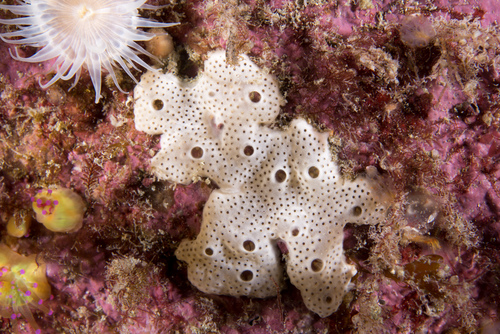
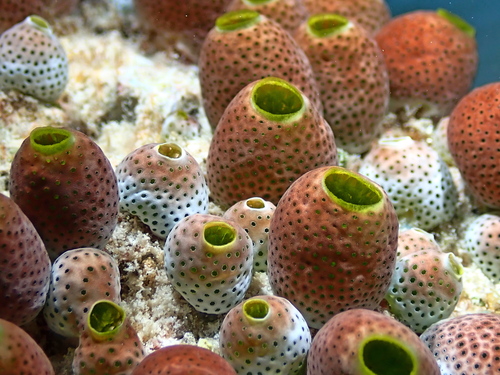
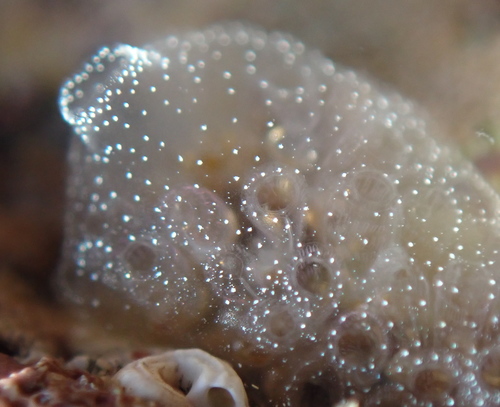
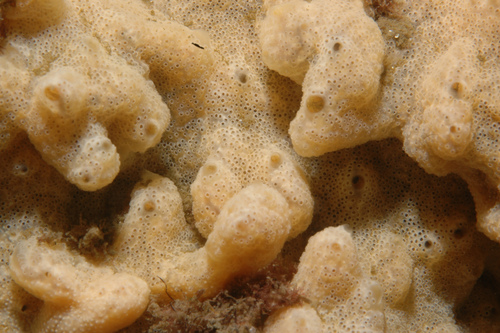
Didemnum vexillum colonies are made up of multiple sac-shaped zooids connected by a shared tunic. Each individual zooid is roughly 1 mm (0.04 in) long, with a buccal siphon that draws water into its interior. Water then moves into a shared common cavity, and is pumped out of the colony through an atrial siphon. The surface of a D. vexillum colony is smooth, leathery, and often has a veined appearance. Buccal siphons appear as many fine pores, while atrial siphons appear as a smaller number of larger holes. Colonies attach firmly to hard surfaces, and can be difficult to detach from these surfaces. This species takes different growth forms in different locations: it can grow as a thin or thick encrusting mat, or as large or small lobes. Colony colour can range from orange, pink, and tan, to creamy yellow or greyish-white. Its tunic is sparsely reinforced by stellate spicules that have nine to eleven rays. In areas with low water movement, colonies can dangle in ropey masses from hard substrates like cables, docks, and boat hulls. These stringy growths have led to the common colloquial name "sea cheese" for this species in Canada. In areas with stronger water currents, colonies form a thin encrusting layer that covers the surfaces of rocks, boulders, pebbles, gravel, and oysterbeds. Didemnum vexillum is thought to be native to Japan, where it was first recorded in Mutsu Bay in 1926. It remains common there, growing on natural rock surfaces and seagrasses (Zostera), and also acting as a fouling organism on cultured bivalves, net cages, pilings, and other man-made structures. It occurs at depths ranging from the intertidal zone down to approximately 80 m (262 ft). In 1969, an iridoviral disease killed most populations of the Portuguese oyster (Crassostrea angulata) cultivated off the Atlantic coasts of France and Portugal. To replace lost oyster stock, large volumes of Pacific oyster (Crassostrea gigas) spat were imported from Japan. Importers attempted to kill any associated fouling organisms by immersing the spat in fresh water for two separate one-hour periods. Despite this effort, brown Didemnum ascidians were reported on regional oyster beds in the early 1970s. Around the same time, Japanese oyster spat was introduced to the Pacific coastal regions of Canada and the United States; an unidentified ascidian was observed shortly after introduction, and later confirmed to be D. vexillum. By 2014, this tunicate had been recorded in the eastern Atlantic, North Sea, and Mediterranean Sea, with established populations in the Netherlands, the United Kingdom, Ireland, France, and Italy. On the east coast of North America, its range extends from New Jersey, New York, Connecticut, Rhode Island, Massachusetts, and New Hampshire, north to Maine. On the eastern Pacific coast of North America, its range stretches from Alaska to California. It is also present in New Zealand, where it was first observed in 2001; this is the only known established population of D. vexillum in the Southern Hemisphere. The Massachusetts Institute of Technology (MIT) developed an autonomous underwater vehicle called "Odyssey IV" that was used to monitor the spread of Didemnum vexillum at George's Bank. Because this ascidian broods its embryos, and its larvae only spend a brief period of time free-swimming, natural dispersal of D. vexillum over long distances is limited. Long-distance dispersal to new habitats across the globe is most likely caused by accidental transport on boat hulls or other floating structures, or accidental introduction to aquaculture sites via commercial oyster spat, seed mussels, or aquaculture equipment.