About Didelphis virginiana Kerr, 1792
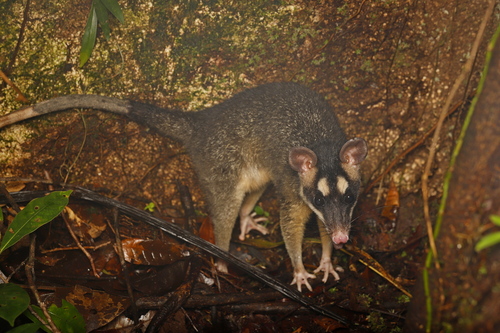
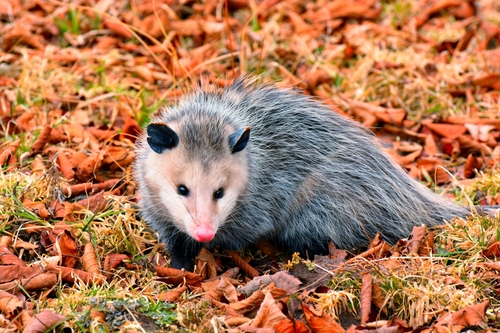
Virginia opossums (Didelphis virginiana Kerr, 1792) vary considerably in size: larger individuals live in the northern part of their range, while smaller individuals occur in the tropics. From snout to the base of the tail, they measure 33–55 cm (13–22 in) long, and the tail adds an additional 25–54 cm (9.8–21.3 in). Males are slightly larger than females: the average male body length is 40.8 cm (16.1 in) with an average tail length of 29.4 cm (11.6 in), while average females reach 40.6 cm (16.0 in) in body length with a 28.1 cm (11.1 in) tail. Male weight ranges from 2.1–2.8 kg (4.6–6.2 lb), and female weight ranges from 1.9–2.1 kg (4.2–4.6 lb). Their coat is dull grayish brown, except for their white faces. This species has long, hairless, prehensile tails that can grab branches and carry small objects, as well as hairless ears and a long, flat nose. Virginia opossums have 50 teeth, more than any other North American land mammal, and opposable, clawless thumbs on their rear limbs. They have 13 nipples, arranged in a circle of 12 with one nipple in the center. Their dental formula is 5.1.3.4 / 4.1.3.4. No other North American mammal has more than 6 upper incisors, but the Virginia opossum has 10. Despite being a widespread, successful species, the Virginia opossum has one of the lowest encephalization quotients of any marsupial, and its brain is one-fifth the size of a raccoon's brain. The ancestors of the Virginia opossum evolved in South America, and spread into North America as part of the Great American Interchange, which occurred mainly after the Isthmus of Panama formed around 3 million years ago. The genus Didelphis was apparently one of the later migrant groups, entering North America around 0.8 million years ago. Today, the Virginia opossum is found throughout Central America and North America, ranging from Costa Rica to southern Ontario, and is significantly expanding its range northward, northwesterly, and northeasterly. Before European settlement, its range generally extended north only as far as Maryland, southern Ohio, Indiana, Illinois, Missouri, and Kansas. The clearing of dense forests by settlers in these areas and further north, plus the elimination of the opossum's main predators in these regions, allowed the species to move northward. Since 1900, its range has expanded to include most of New England (including Maine), New York, extreme southwestern Quebec, most of southern and eastern Ontario, most of Michigan and Wisconsin, most of Minnesota, southeastern South Dakota, and most of Nebraska. In the 1960s, opossums were rarely sighted in areas like Rhode Island and Waterloo Region and Simcoe County in southern Ontario, but they are regularly seen there now; some speculate this is likely due to global warming leading to warmer winters. Some people suggest that most expansion into Ontario happened when opossums were accidentally carried across the St. Lawrence, Niagara, Detroit, and St. Clair rivers by motor vehicles or trains that the animals had climbed onto. Because the Virginia opossum is not adapted to cold winters or heavy snow, its population in a given northern region may be significantly reduced after a cold winter with heavy snowfall. The Virginia opossum was not originally native to the West Coast of the United States. It was intentionally introduced to the West during the Great Depression, probably as a source of food, and now occupies much of the Pacific coast. Its range has been steadily expanding northward into British Columbia. Small isolated opossum populations also occur in eastern New Mexico and parts of southern and central Arizona, particularly around Tucson. It is unknown whether these populations are native to these regions or were introduced at some point. The Virginia opossum's breeding season can start as early as December and continue through October, with most young born between February and June. A female may have one to three litters per year. During mating season, males attract females by making clicking sounds with their mouths. The female's estrus cycle is 28 days, and estrus itself lasts 36 hours. Gestation lasts 11–13 days, and the average litter size is 8–9 infants, though over 20 infants may be born. Virginia opossums have a very high mortality rate for young, with only one in ten offspring surviving to reproductive adulthood. Newborn opossums are about the size of a honeybee. After birth through the median vagina (central birth canal), newborns climb into the female's pouch and latch onto one of her 13 teats. Young remain latched for two months, and stay in the pouch for two and a half months. After this period, the young climb onto the mother's back, where she carries them for the rest of their time together. Young learn survival skills during this time on their mother's back, and leave their mother after four to five months. Like all female marsupials, the female Virginia opossum has a bifid reproductive system with two lateral vaginae, uteri, and ovaries. The male's penis is also bifid, with two heads, and as is common in New World marsupials, sperm pair up in the testes and only separate as they approach the egg. Males have three pairs of Cowper's glands.