About Dictyotus caenosus (Westwood, 1837)
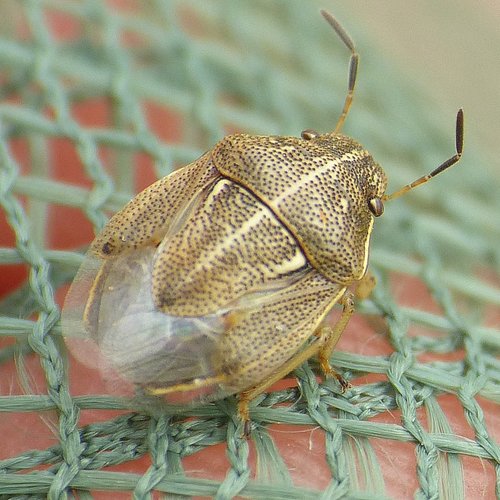
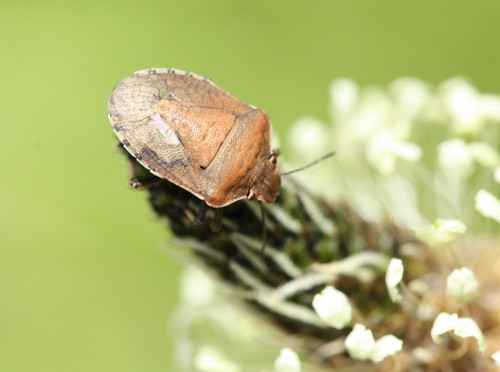
Adults of Dictyotus caenosus measure 8 to 10mm in length. They are predominantly brown, with a yellow connexivum on the sides of the abdomen that is interrupted by black bars. Eggs are approximately 0.9mm in both height and diameter. When first laid, they are pale yellowish-green, then turn lemon yellow, and finally become pink just before hatching. This species, commonly called the brown shield bug, is native to Australia, where it is widespread across grassy areas. It is an adventive species in New Zealand, where it is also widespread. In New Zealand, it associates with wild grasses like Plantago, and pasture crops such as lucerne. It is also found in New Caledonia. The life cycle of Dictyotus caenosus matches that of other species in the Pentatomidae family. Adults mate in spring and late summer, and lay eggs in early summer. Eggs are laid in clusters of around 18, placed on leaves or at the base of plants. As the embryos develop inside, the eggs darken, and the nymph’s eye spots and egg burster become visible. All nymphs hatch around the same time, and stay near the egg mass until they moult into the second nymph stage, or instar. When moulting, the nymph sheds its outer exoskeleton, which remains on the host plant. Nymphs go through five instars before a final moult into the adult form. Adult brown shield bugs can fly, while nymphs can only disperse by walking. Adults are most abundant from January to March. Individuals that survive to the end of the active season overwinter at the base of plants or under stones. In New Zealand, D. caenosus is commonly associated with herbaceous plants and grasses across many different habitat types. It is frequently found on roadsides, in swamps, scrubland, at the edges of cultivated fields, and in paddocks. Its recorded host plants include Brassica rapa, Fragaria sp., Medicago sativa, Pisum sp., Rubus spp., Solanum aviculare, Trifolium repens, Zea mays, fodder beet, grapes, turnips, and potatoes. It sometimes occurs on native New Zealand plants including Avicennia marina subsp. australasica, Carmichaelia sp., Olearia, Coprosma rhamnoides, Cordyline australis, Dacrydium cupressinum, Festuca novae-zelandiae, Hebe salicifolia, Muehlenbeckia sp., and Myoporum laetum. Several natural enemies have been recorded that use D. caenosus as a host: the tachinid fly Cylindromyia bimacula (Walker) in Australia, and the platygastrid egg parasitoids Trissolcus basalis (Wollaston) and T. oenone (Dodd) in New Zealand.