About Dicrurus paradiseus (Linnaeus, 1766)
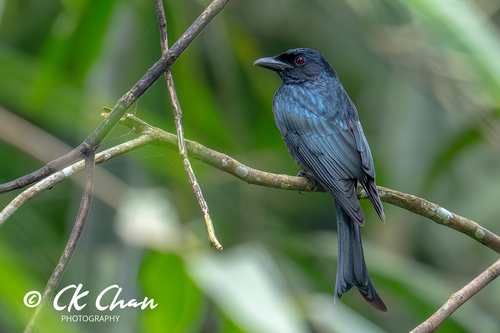
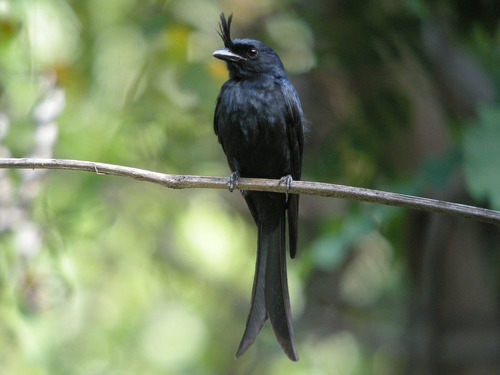
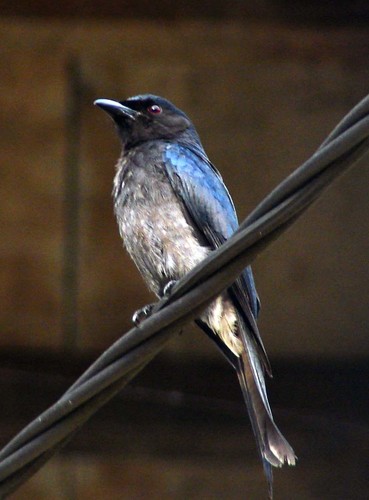
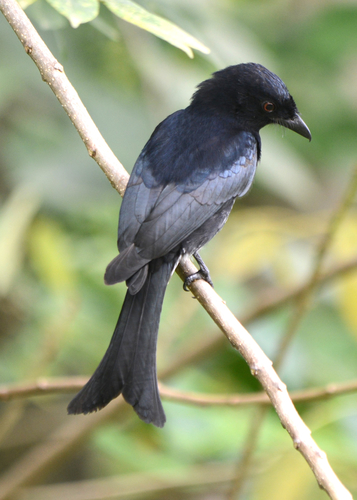
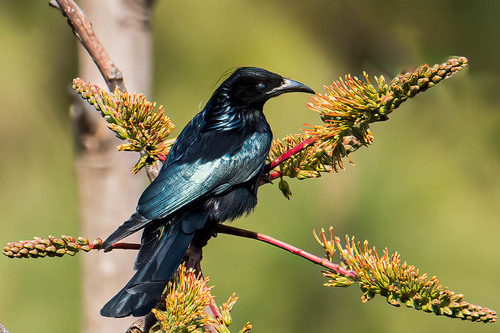
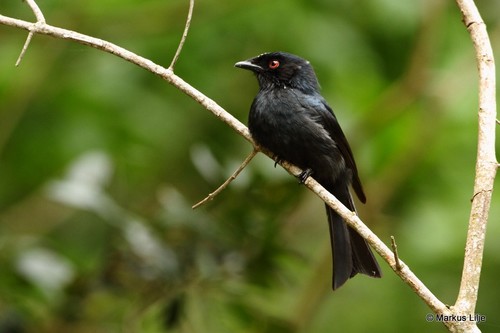
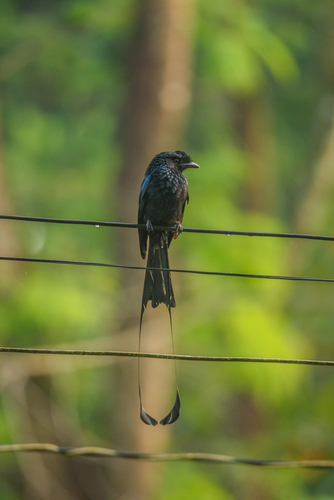
This species, the greater racket-tailed drongo, Dicrurus paradiseus, is the largest drongo species across most of its Asian range. It is easily identified by its distinctive tail rackets and a crest of curled feathers that starts in front of the face above the beak and extends along the crown; the extent of this crest varies by subspecies. Its tail has twisted rackets, a unique feature that can look like two large bees chasing a black bird when the bird is in flight. In the eastern Himalayas, this species can be confused with the lesser racket-tailed drongo, but the lesser racket-tailed drongo has flat tail rackets and almost no crest. This widespread species has populations with distinct variations, and multiple subspecies have been formally named. The nominate subspecies occurs in southern India, mainly in forested areas of the Western Ghats and the adjacent hill forests of peninsular India. The Sri Lankan subspecies is ceylonicus, which resembles the nominate form but is slightly smaller. The subspecies found along the Himalayas is grandis, the largest subspecies, which has long glossy neck hackles. The Andaman Islands subspecies otiosus has shorter neck hackles and a highly reduced crest, while the Nicobar Islands subspecies nicobariensis has a longer frontal crest and smaller neck hackles than otiosus. The Sri Lanka drongo (D. lophorinus) was previously treated as a subspecies of Dicrurus paradiseus, because it was thought to hybridize with D. p. ceylonicus, but it is now considered a separate species due to their overlapping ranges. Specimens of the nominate Dicrurus paradiseus have sometimes been confused with the separate Sri Lanka drongo species. Considerable variation in bill shape, and the extent of crests, hackles, and tail rackets occurs among island populations of Dicrurus paradiseus in Southeast Asia. The Bornean subspecies brachyphorus (also called insularis) and the Banggai Islands subspecies banguey both lack crests; the banguey subspecies does have frontal feathers that arch forwards. Very reduced crests are seen in microlophus (also called endomychus, from the Natuna, Anambas, and Tioman Islands) and platurus (from Sumatra). A number of additional forms are recognized across Southeast Asian islands and the mainland, including formosus from Java, hypoballus from Thailand, rangoonensis from northern Burma (central Indian populations were previously assigned to this subspecies), and johni from Hainan. Young greater racket-tailed drongos have duller plumage, and may lack a crest; moulting individuals can lack the elongated tail streamers that form the base of the tail rackets. The racket is formed by the inner web of the feather vane, but it appears to be on the outer web because the rachis twists just above the broad spatula-shaped end of the racket. The distribution range of this species extends from the western Himalayas to the eastern Himalayas and Mishmi Hills, found in foothills below 1,200 m (3,900 ft). It also occurs in the hills of peninsular India and the Western Ghats, and continues east through the Asian mainland and islands to Borneo and Java. Like other drongos, greater racket-tailed drongos feed mainly on insects, but also eat fruit and visit flowering trees to feed on nectar. They have short legs, so they sit upright and are often perched on high, exposed branches. They are aggressive, and will sometimes mob larger birds, particularly during nesting. They are often active at dusk. Their calls are extremely varied, and include monotonously repeated whistles, metallic and nasal sounds, more complex notes, and imitations of other birds' calls. They begin calling as early as 4 am when there is moonlight, often producing a repeated metallic tunk-tunk-tunk sequence. This drongo can accurately mimic the alarm calls of other birds, learning these calls through interactions in mixed-species flocks. This is unusual, because avian vocal mimicry was previously thought to occur without awareness of the original context of the imitated call. Grey parrots are known to use imitated human speech in the correct context, but do not show this context-sensitive mimicry behaviour in natural settings. The greater racket-tailed drongo's context-sensitive use of other species' alarm calls is therefore analogous to a human learning useful short phrases and exclamations in multiple foreign languages. The species gives a special alarm call in the presence of shikras, transcribed as a loud kwei-kwei-kwei...shee-cuckoo-sheecuckoo-sheecuckoo-why!. It has been reported to imitate raptor calls to alarm other birds, then steal prey from them when the other birds panic. It also imitates the calls of species that typically join mixed-species flocks, such as babblers; one record even notes the drongo fluffing up and moving its head and body like a jungle babbler while imitating its calls. Researchers have suggested this mimicry plays a role in the formation of mixed-species flocks. In some locations, greater racket-tailed drongos act as kleptoparasites towards other members of mixed-species flocks, particularly laughingthrushes, but they most often participate in mutualistic or commensal relationships with other birds. Multiple observers have recorded this drongo associating with foraging woodpeckers, and there is one record of a greater racket-tailed drongo following a troop of macaques. The greater racket-tailed drongo is a resident breeder throughout its entire range. In India, the breeding season runs from April to August. Courtship displays may involve hops and turns on branches, plus play behaviour where the bird drops an object and catches it in mid-air. The species builds a cup-shaped nest in the fork of a tree, most often a smooth-boled tree with an isolated canopy. The nesting pair may even remove small pieces of bark from the tree trunk to make it smoother. The usual clutch size is three to four eggs. The eggs are creamy white with reddish brown blotches that are more densely concentrated at the broader end of the egg.