About Dicrurus macrocercus Vieillot, 1817
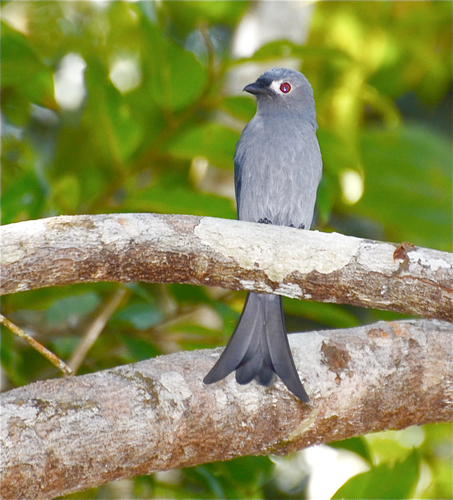
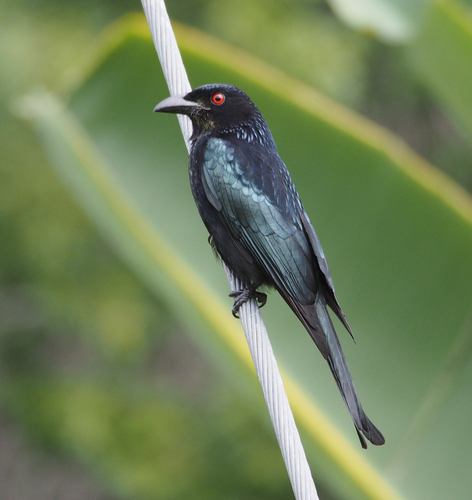
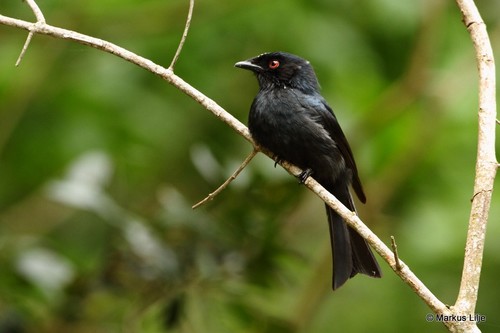
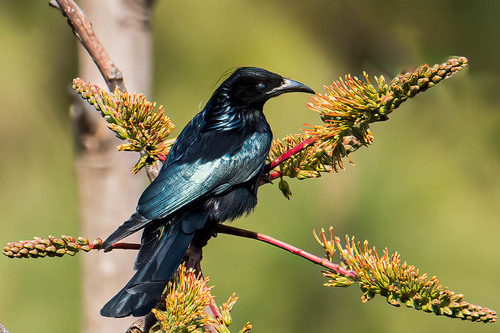
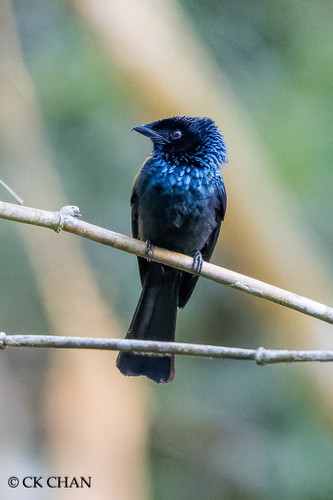
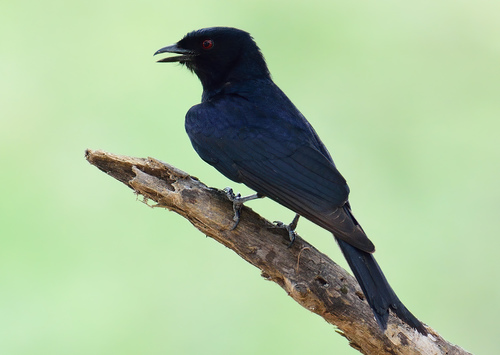
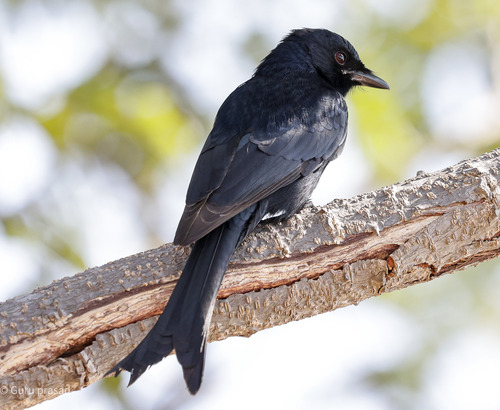
This species, Dicrurus macrocercus, commonly called the black drongo, is a glossy black bird with a deeply forked tail. Adults typically have a small white spot at the base of the gape, and their irises are dark brown, unlike the crimson irises of the similar ashy drongo. The sexes cannot be distinguished from one another in the field. Juveniles are brownish, often with white barring or speckling on the belly and vent, and can be confused with the white-bellied drongo. First-year individuals have white-tipped belly feathers, while second-year individuals only have white-tipped feathers on the vent. Black drongos are aggressive and fearless. At only 28 cm (11 in) long, they will attack much larger species that enter their nesting territory, including crows and birds of prey. This behavior gave them their former common name, king crow. They fly with strong wing flaps, and are capable of fast maneuvers that let them capture flying insects. With short legs, they sit upright on thorny bushes, bare perches, or electricity wires, and may also perch on grazing animals. They can produce a wide range of calls; a common two-note tee-hee call resembles that of the shikra (Accipiter badius). Black drongos live predominantly in open country, and usually perch and hunt close to the ground. They are mostly aerial predators of insects, but also glean food from the ground or vegetation. They occur as summer visitors to northeastern Afghanistan and northern Pakistan, and are resident from the Indus Valley through Bangladesh, India, and Sri Lanka. Some populations have poorly understood seasonal movements, and populations in Korea are known to be migratory. This species can be found in savannas, fields, and urban habitats. Black drongos were introduced from Taiwan to the island of Rota just before the Second World War to help control insects. They are believed to have dispersed across the sea to Guam in the 1950s. By 1967, they were the fourth most commonly observed bird in roadside counts on Guam, and are today the most abundant bird there. Predation by and competition from black drongos have been suggested as factors in the decline of endemic bird species including the Rota bridled white-eye and the Guam flycatcher. Black drongos become active very early at dawn and roost later than many other bird species. They feed mainly on insects including grasshoppers, cicadas, termites, wasps, bees, ants, moths, beetles, and dragonflies. They sometimes fly close to tree branches to disturb resting insects. They gather in ploughed fields to feed on exposed caterpillars and beetle grubs, and congregations as large as 35 birds have been recorded at these sites. They are also attracted to fires in scrub and grassland habitats, where insects are driven out into the open. They appear to avoid flies. They associate with common mynas, cattle egrets, and other birds that share similar diet and habitat; this association benefits black drongos, improving their foraging success. There is only partial overlap in the insect prey sought by mynas and drongos, though black drongos may rarely rob prey from mynas. They are reported to imitate the call of the shikra to scare mynas into flight, then steal the prey the mynas leave behind. Similar behavior using false alarm calls has been recorded in the fork-tailed drongo. There are documented cases of black drongos preying on small birds, reptiles, and possibly bats. It has been suggested that black drongos may prey on birds more frequently during migration; one individual on a migratory stop-over island in Korea caught several birds in succession, killing them by striking the back of the head and neck and feeding selectively on parts, especially the brain. Black drongos have also occasionally been observed feeding on fish. They may visit the flowers of trees like Erythrina and Bombax for water and nectar, and are sometimes known to feed on grains. They only rarely consume larger arthropods such as scorpions and centipedes. They eat milkweed butterflies, which are often avoided by other predators, and may feed late in the evening or at night, often on insects attracted to artificial lights.