About Dicrurus leucophaeus Vieillot, 1817
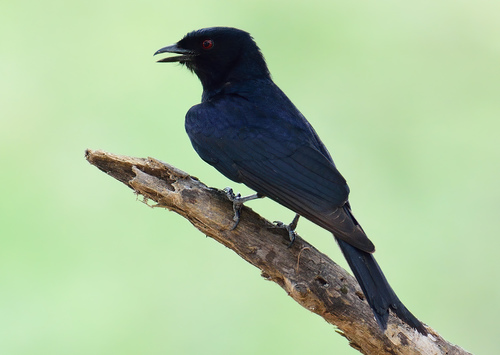
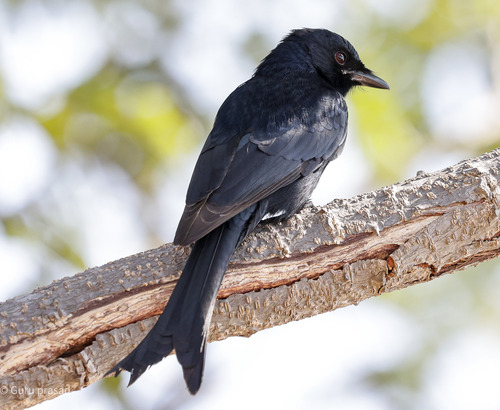
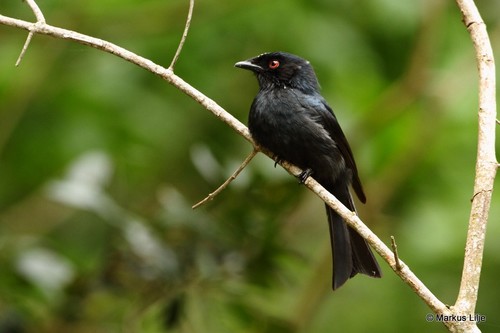
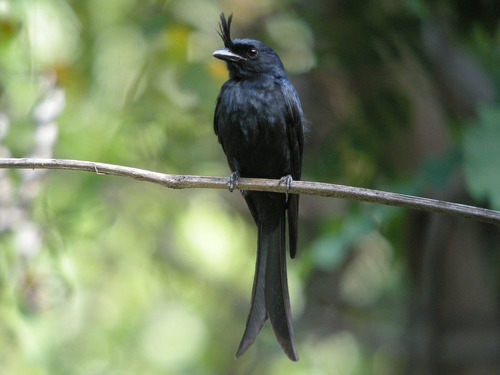
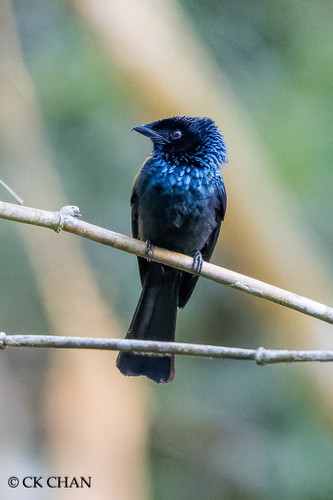
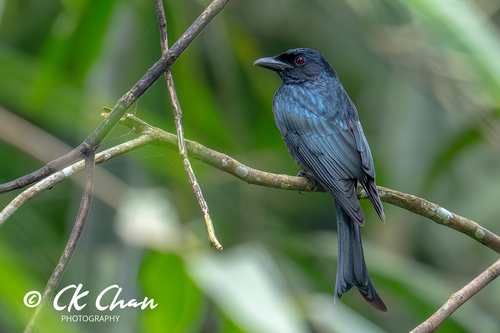
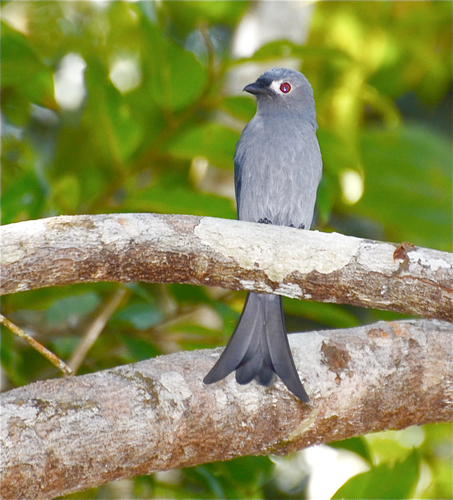
Dicrurus leucophaeus Vieillot, 1817, commonly known as the ashy drongo, has the following description. Adult ashy drongos are mainly dark grey, with a long, deeply forked tail. Multiple subspecies exist that differ in the shade of their grey plumage; some subspecies have white markings on the head. Young birds are dull brownish grey. The subspecies longicaudatus found in India includes the Himalayan population beavani, which winters on the Indian peninsula. Vaurie separates a central Indian breeding population as longicaudatus in the restricted sense. This subspecies is very dark, and looks almost like the black drongo, but it is slimmer, with a somewhat longer, less splayed tail. It occupies tall forest habitat, and has a dark grey underside that lacks the sheen seen on black drongos. It has a crimson iris and no white rictal spot. Subspecies leucogenis, salangensis, and several southern island breeding forms have a white eye-patch. The calls of ashy drongos are a little more nasal and twangy than those of the black drongo. The ashy drongo breeds in the hills of tropical southern Asia, ranging from eastern Afghanistan eastward to southern China, the Ryukyu Islands of southern Japan (especially Okinawa), and Indonesia. Most populations in the northern part of its range are migratory. Charles Vaurie described subspecies beavani (named for Robert Cecil Beavan) as the Himalayan breeding population that winters in peninsular India; later researchers include this population as part of longicaudatus, which also has a breeding population in central India. During winter, this species favors hill forests. E. C. Stuart Baker described subspecies stevensi, which Vaurie classified as either beavani or hopwoodi from the eastern Himalayas. East of the range of hopwoodi is subspecies mouhouti, found in Thailand and Myanmar. North of mouhouti's range are leucogenis and salangensis, both of which migrate mainly further south, though they have also been recorded from Nagaland, while subspecies bondi is found to the south of mouhouti's range. Along the southeast Asian island chain, there are multiple insular populations: periophthalmus, ryukyuensis, batakensis, phaedrus, siberu, and nigrescens. The nominate subspecies is found on Simalur, Java, Bali, Lombok, Palawan, and Balabac Islands. Ashy drongos have short legs, and sit very upright when perched prominently, often high in a tree. They are insectivorous, foraging by making aerial sallies, and sometimes glean food from tree trunks. They are usually found singly, in pairs, or in small groups; during migration they travel in small flocks. A common call is described as drangh gip or gip-gip-drangh. They can imitate the calls of other birds, including the whistling notes of a common iora. Their breeding season runs from May to June. They lay a clutch of three or four reddish or brown eggs in a loose cup nest built in a tree.