About Dicrurus caerulescens (Linnaeus, 1758)
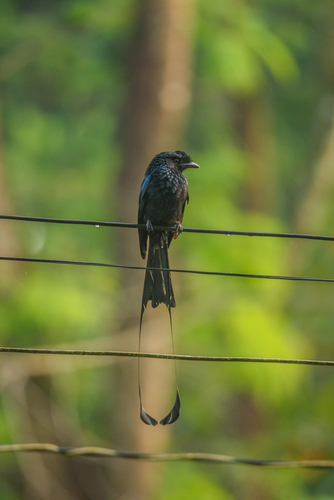
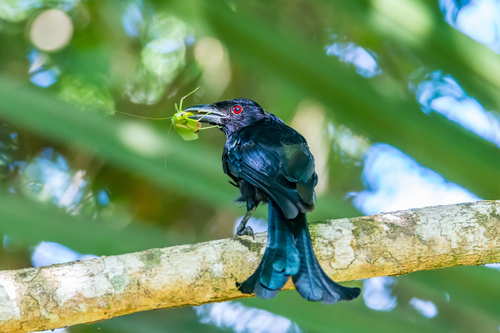
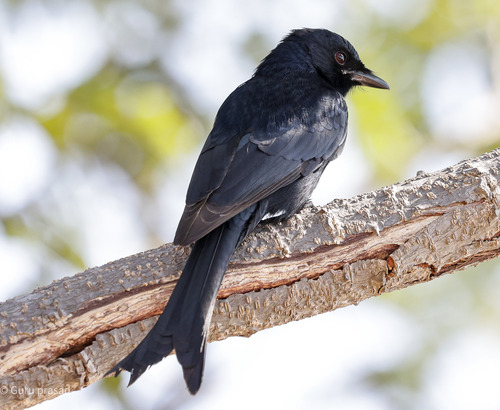
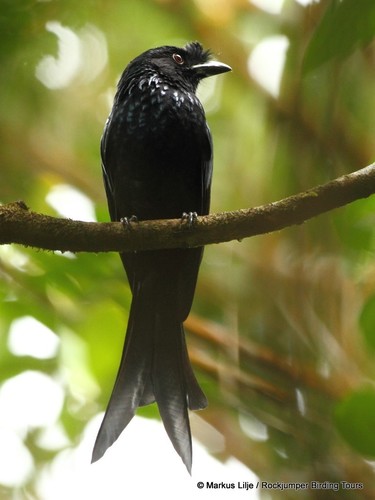
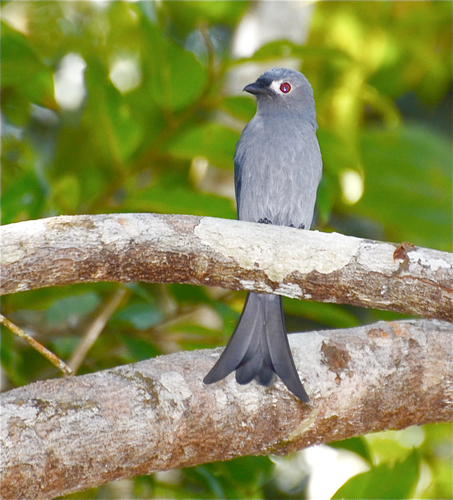
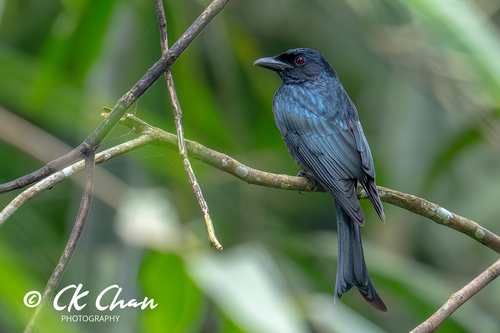
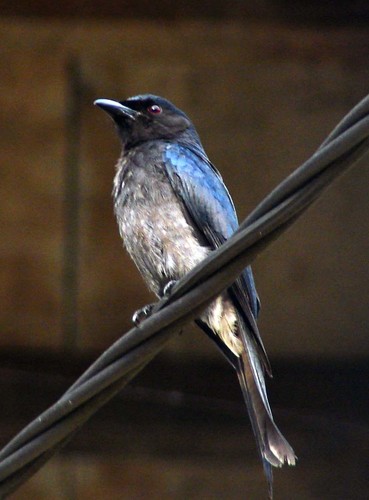
This species is commonly known as the white-bellied drongo, with the scientific name Dicrurus caerulescens (Linnaeus, 1758). For the nominate subspecies, which is the Indian form, adult individuals are black with no glossy feathers on the upperside. Their throat and breast are greyish, while the belly and vent are entirely white. The fork of this species' tail is less deep than that of the black drongo, a species that often shares the same habitats. Young black drongos can have extensive white on the underside, but this white usually has a scaly appearance. In the two Sri Lankan forms, insularis from the northern dry zone and leucopygialis from the southern wet zone, the white coloration is restricted only to the vent. Birds under one year old do not have white on the underside; they are browner on the upperside and greyish on the underside. On average, males have a very slightly shorter tail than females. Body size varies clinally across the species, with northern individuals being larger. The extent of white on the underside also decreases as body size increases, though there is substantial local variation. The two Sri Lankan forms are darker than the Indian form, and there is some intergradation between the Sri Lankan forms. This species is thought to be closely related to Dicrurus leucophaeus, but this relationship has not been confirmed by molecular sequence studies. Both the white-bellied drongo and the black drongo have a diploid chromosome number of 68. The white-bellied drongo is a resident breeding species found in India and Sri Lanka. It is most often found in dry scrub or open forests. Its distribution is restricted to peninsular India, located south of the Himalayas, west of the Gangetic delta, and bounded to the west by the Aravalli Range. White-bellied drongos are most commonly seen alone, or in groups of up to three individuals. They sometimes join mixed-species foraging flocks. They perch upright near the tops of trees, and capture insects in the air with short aerobatic sallies. They may use their claws to capture larger insects. Their song consists of a series of staccato notes interspersed with clear notes, and may include mimicry of other bird calls. The breeding season runs from February to July. They build cup-shaped nests that are similar to the nests of black drongos, but are typically constructed with more twigs and well lined with grass. They lay two to four pale salmon-colored eggs, which have reddish blotches on the broad end. Nests are placed 20 to 30 feet high in the fork of a tree. White-bellied drongos are aggressive around their nest, and will attack potential threats that are much larger than themselves. When mobbing threats, they have been observed to imitate the alarm calls of squirrels or the mewing of a cat. They are primarily insectivorous, but are also opportunistic, and are known to prey on small birds. Like other drongos, they use their feet to handle their prey. They have been recorded taking insects attracted to artificial lights in late dusk. They also visit large flowers, particularly Bombax and Erythrina, to feed on nectar, and may pollinate species such as Helicteres isora. The bird louse Philopterus kalkalichi, whose type host is the black drongo, has also been found living on white-bellied drongos.