About Dicrurus adsimilis (Bechstein, 1794)
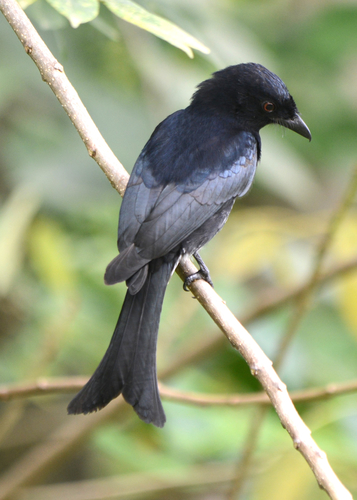
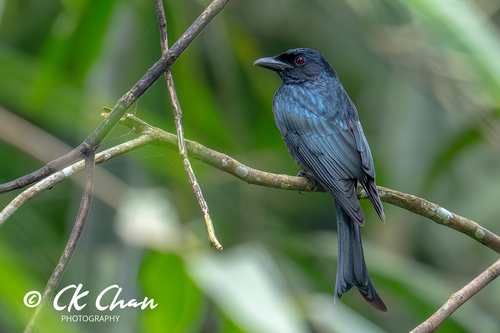
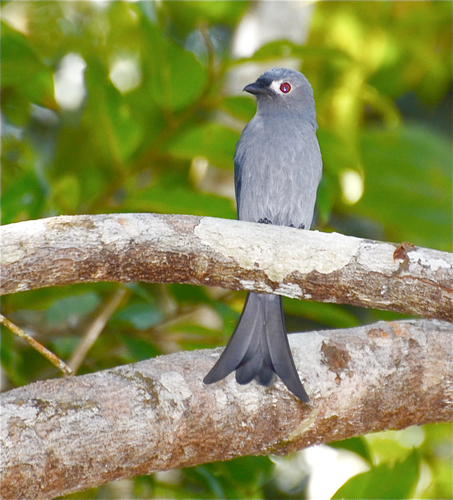
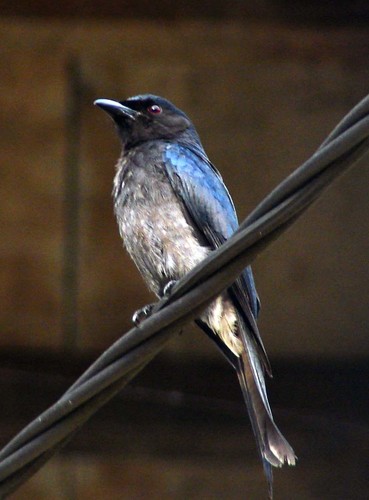
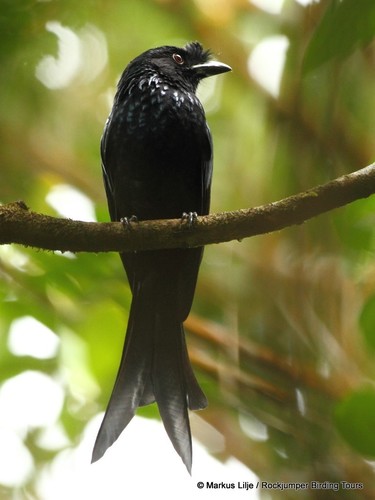
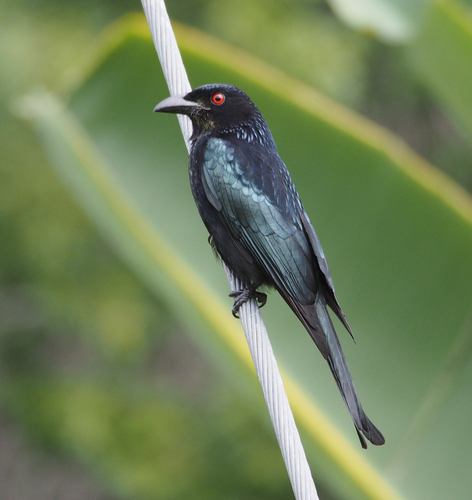
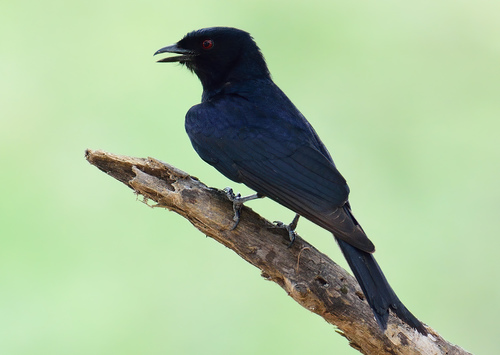
Fork-tailed drongos (Dicrurus adsimilis) have robust black beaks and red eyes in adulthood. Newly hatched fork-tailed drongos have no feathers, with reddish skin, an orange beak, a yellow gape flange, brown eyes, and a black beak. Juvenile fork-tailed drongos are dark brown with some buff-colored feather tips, have a less pronounced tail fork, brown or grey eyes, and a pale mouth. Juveniles resemble adults, but lack glossy color on the lower body and have pale feathers in some areas. Both adult males and females have black bodies with blue-green iridescence on specific regions. The underside including the belly is uniformly black, which contrasts with the glossy black-blue upper body. Their long tail is deeply forked and black, measuring approximately 115–126 mm in length and 19–23 mm in depth. They have short legs and a wingspan of 134 mm. Their bill has a depth of 0.4 mm and a length of 2.8 mm. After breeding, adult fork-tailed drongos undergo a complete molt. This molt usually occurs between December and March in Southern Africa, and happens in different months in other regions. Young birds keep their immature plumage until the next breeding season. A partial post-juvenile molt begins before new wing and tail feathers grow after the nesting period. Cases of leucism have been recorded in fork-tailed drongos. The fork-tailed drongo is a common and widespread resident breeding bird native to Africa south of the Sahara. This insect-eating species most often lives in open woodland, savanna, and forest edge, and can tolerate arid climates. Its range was previously thought to extend into Asia, but the Asian population is now classified as a separate species, the black drongo (D. macrocercus). The fork-tailed drongo can be found at elevations up to 2200 meters.