About Dicromantispa sayi (Banks, 1897)
Scientific name: Dicromantispa sayi (Banks, 1897)
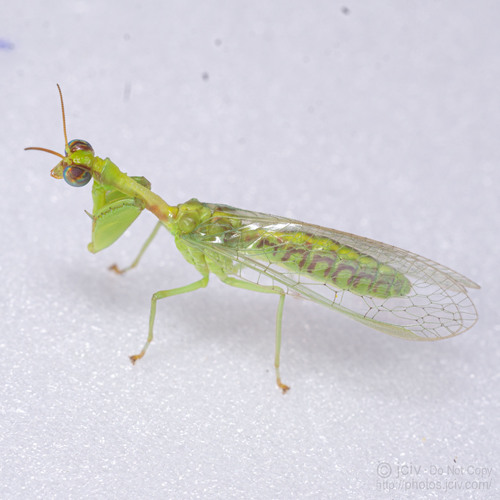
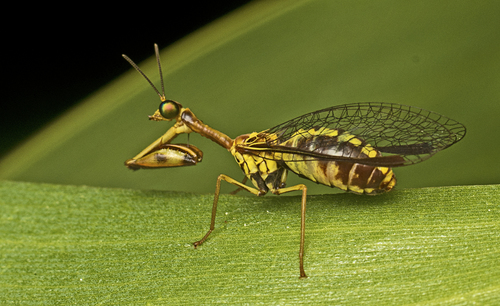
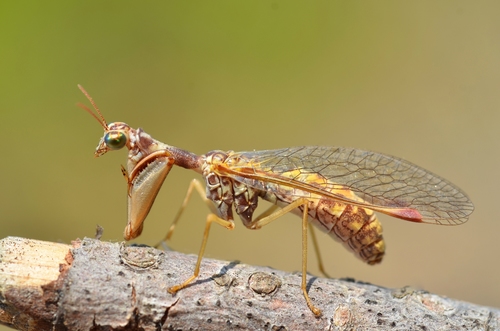
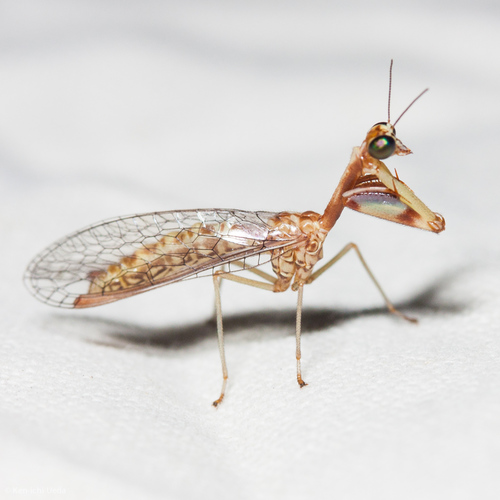
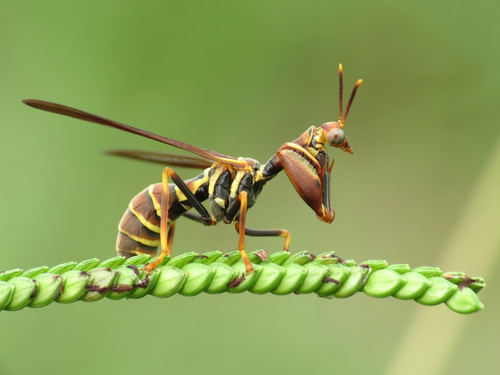
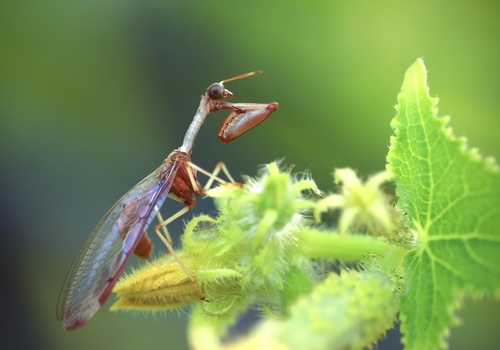
Identification: Head: Color ranges from brown to black, with pale yellow markings. A longitudinal yellow stripe runs along each side of the face center, leaving a dark middle area that appears as an incomplete dark stripe in some individuals. The top of the head has a pattern of yellow oblong spots, which can be obscure. Eyes are multi-colored. Antenna: Antennae are brown, except the first segment is yellowish, particularly on the underside.
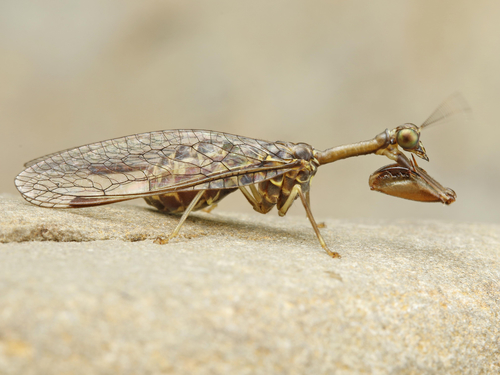
Thorax: The prothorax (neck) is long and slender, and more cone-shaped toward the head. It has cream-colored patches at its base and end; the rest of the prothorax ranges from yellowish-brown to dark brown. There is usually a longitudinal stripe of either light or dark color running down its center. On females, the side of the thorax is dark with curved cream-colored lines. On males, the sides of the thorax are mostly pale.
Wings: Wings are clear with brown veins, and have no brown spots at the wing tips. The base and outer edge of the wings (the costa area) are dark brown, with a faint yellowish streak. The stigma at the end of the costa is also dark brown.
Legs: The front legs are modified, similar to those of a praying mantis. They are dark brown with light streaks, and are usually folded and not used except when eating. Mid and hind legs are pale yellow with brown streaks. In females, the coxae (the leg segment connecting to the body) are brown; in males, the coxae are pale.
Abdomen: The abdomen ranges from yellowish-brown to dark brown, with yellow markings. Female abdomens are always darker, and may be entirely black; yellow markings vary a great deal between individuals. The side edges of the abdomen are cream; this cream color covers almost all of the edges on males, while it appears as more distinct spots on females.
Similar Species: Dicromantispa interrupta is a larger species that has a dark patch near the wing tip. Leptomantispa pulchella has paired yellow stripes of even width running down the sides of the abdomen, while D. sayi has an uneven width pattern along the abdomen sides. L. pulchella also has a bright burnt orange stigma on the wings, unlike the brown stigma of D. sayi. Aside from these differences, the two species are identical.
Size: Adults are 14 to 15 mm long. Habitat: This species lives in forest edges and prairies where spiders are present. Food: Adult D. sayi feed on small flying insects. Larvae hunt spider eggs; major known hosts include wolf spiders (Lycosidae) and the running crab spider Philodromus vulgaris. Flight period: Adults are active in flight from July 15 to September 4, with peak activity at the end of July. Life Cycle: Females lay eggs on any substrate. After hatching, larvae wander to find spider egg sacs, which they penetrate, or hitch a ride on adult female spiders that are ready to lay eggs. The first instar overwinters. There is one generation per year.