About Dicranum scoparium Hedw.
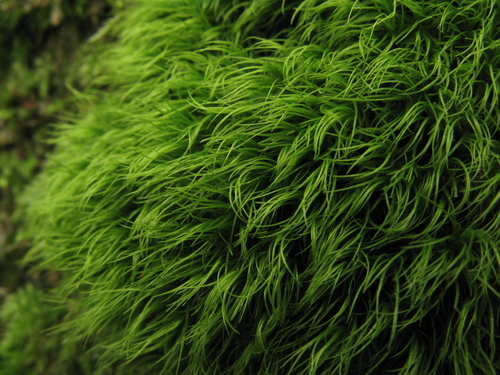
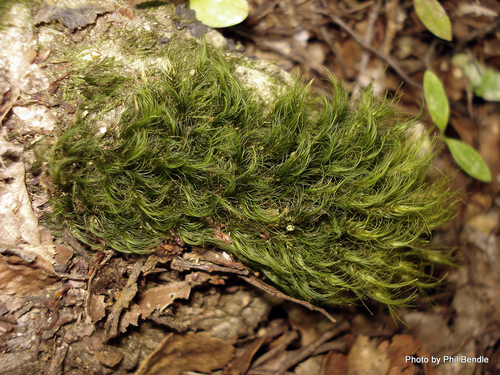
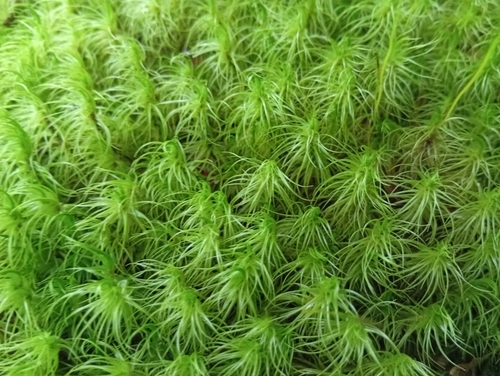
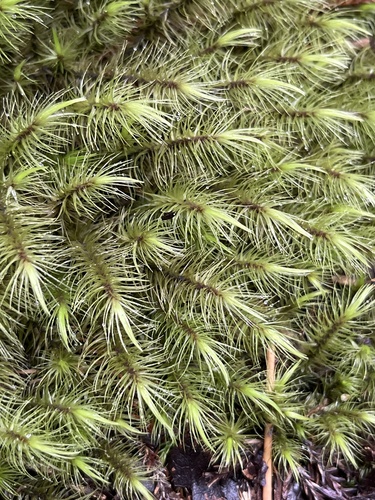
Dicranum scoparium Hedw., commonly called broom forkmoss, is typically robust and coarse. It forms shiny tufts with woolly stems that grow 2–8 cm (0.79–3.15 inches) high. The leaf midrib extends all the way to the leaf tip, and usually has four ridges along its back. Its leaves measure 3.5–8 mm (0.14–0.31 inches) long, are lance-shaped with a long, slender point, and have prominent teeth along the upper third of their length. Most leaves are folded and curved toward one side, though they may also be wavy. This species produces urn-shaped, curved capsules that are 2.3–5 mm long. The capsules are held on mostly upright stalks that are 18–35 mm (0.71–1.38 inches) long. The operculum, or capsule lid, is usually longer than the capsule itself. Male D. scoparium are less common than females, and males are typically dwarfed in size compared to females. As a bryophyte, Dicranum scoparium has multicellular rhizoids, which are root-like structures that help with water absorption and anchor the plant to the ground. Broom forkmoss is distributed across North America (excluding Labrador, North Dakota, Texas, and Nevada), Europe, Asia, northern Africa, Australia, and New Zealand.