About Dicranopalpus caudatus Dresco, 1948
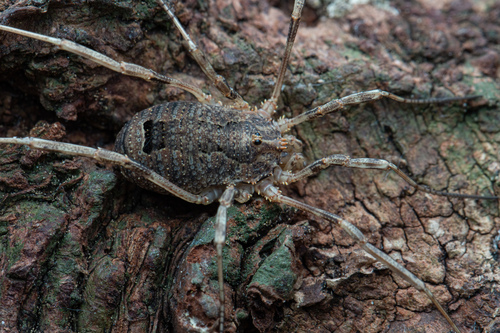
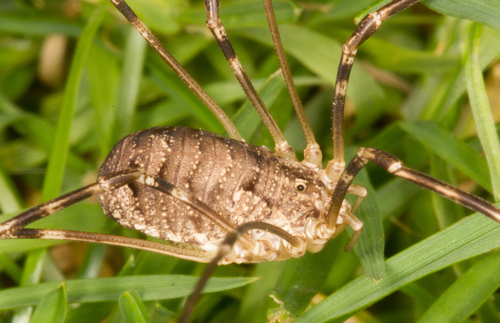
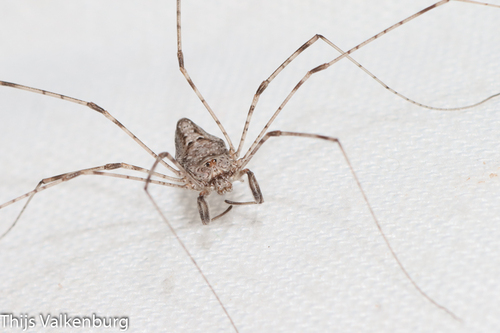
Dicranopalpus ramosus is a species of harvestman. Males grow up to 4 mm long, while females can reach up to 6 mm in length. Both sexes have very long legs — the second pair in particular can reach up to 5 cm — and their pedipalps have a forked shape, caused by a distinct elongated apophysis that extends almost to the end of the tibia. Their bodies are brownish with dark markings, and females are lighter in color than males. This species is easy to identify thanks to its forked pedipalps and resting posture, where it holds its legs stretched out to the sides. Traditional invertebrate collection methods are not very effective for this species: out of 103 individuals captured in Belgium, only one was caught in a pitfall trap, and all others were collected by hand. Adult D. ramosus can be found from August to November. They occur mostly in gardens and on outer building walls, and can sometimes be found inside buildings as well. Originally, this species was native to Morocco. It later spread into Europe, with the first recorded occurrence outside Morocco in Portugal in 1948. From Portugal it spread to Spain in 1965 and France in 1969, reached the Netherlands in 1992, and has been recorded in Germany since 2004. As early as 1957, it was recorded in Bournemouth, southern England; from there it spread across all of Great Britain, reaching Scotland in 2000. It has been established in most of Denmark since 2010, and in southern Sweden since 2012. In 2019, an individual photographed by iNaturalist user "kiwikiu" at Cannon Beach, Oregon indicated that the species had been introduced to the United States. Since that observation, the species has been documented multiple times in the Cannon Beach area. A very similar, closely related species, D. gasteinensis, is found in the Alps.