About Dicranomyia aegrotans Edwards, 1923
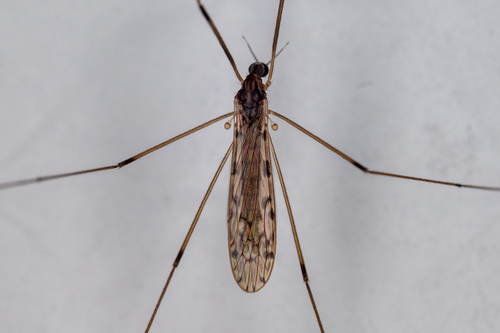
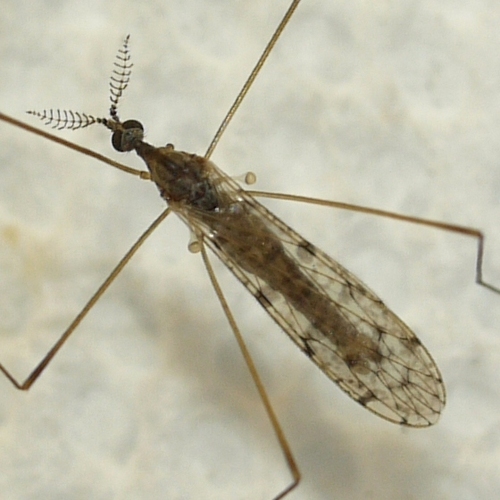
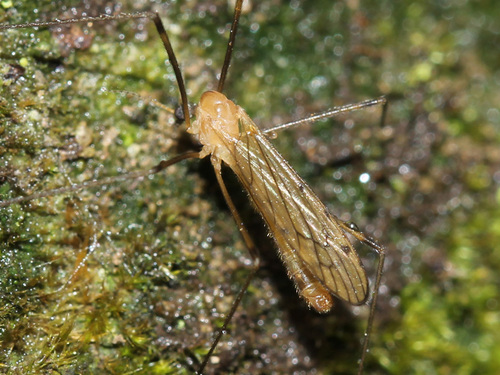
This species, Dicranomyia aegrotans, was originally described by Edwards based on a female specimen, with the details below. The head is heavily dusted with light ash-grey, and the frons is apparently about one-fifth as broad as the entire head. The proboscis and palpi are dark brown, and measure approximately half the length of the head. The first antennal joint is dusted with grey, while the remaining antennal segments are blackish. The flagellar joints are rounded, with the last six or seven being shortly oval, and the verticils are slightly longer than the joints themselves. The thorax is brown, and heavily dusted with pale grey; the praescutum has three stripes that show the brown ground color of the structure. The abdomen is dark brown, with the last segment and the ovipositor colored reddish. The anal valves of the ovipositor are slender and curved, and are slightly shorter than the last abdominal segment; the genital valves are somewhat narrowed along their apical half. The legs are rather light brown, with the tips of the femora slightly darker in color. The wings are rather narrow, with a faint milky tint; the base of the wing, along with veins Sc and R, is white, while the remaining veins are dark. Vein Cu is slightly clouded, and the stigma is dark brown, small, and roundish, and is bisected by the cross-vein. Vein Sc1 ends slightly beyond the base of Rs, and is scarcely twice as long as the oblique Sc2. Rs is gently curved, and is about twice as long as the basal section of R4+5, and nearly two-thirds as long as R2+3. A distinct fold crosses the r-m cross-vein. The discal cell is fully twice as long as it is broad, and is open to cell M1 on one of the specimen's wings. The halteres are light ochreous. The total body length of the species is 5 millimetres, and the wing length is 6 millimetres. This species is found widely across New Zealand, and also occurs in the Kermadec Islands.