About Dicranoloma menziesii (Taylor) Broth. ex Renauld
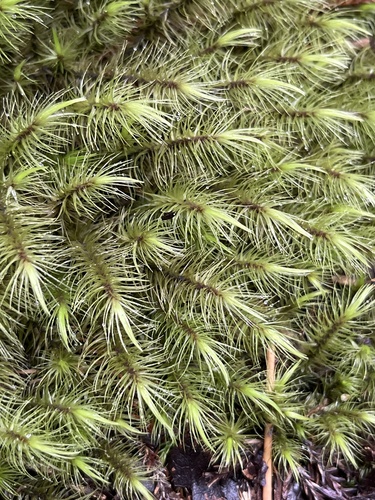
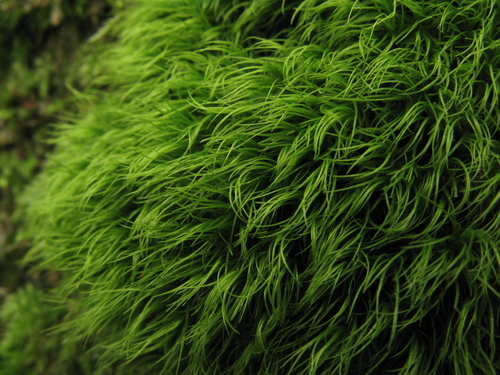
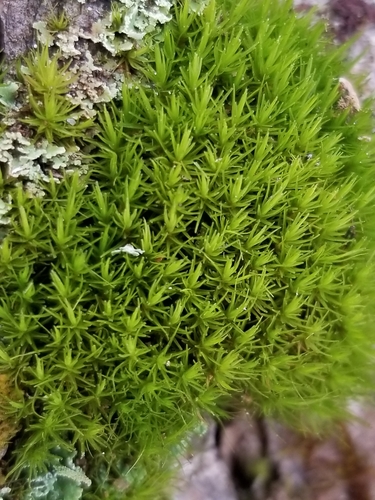
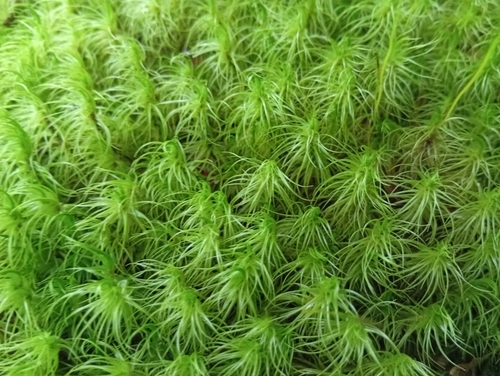
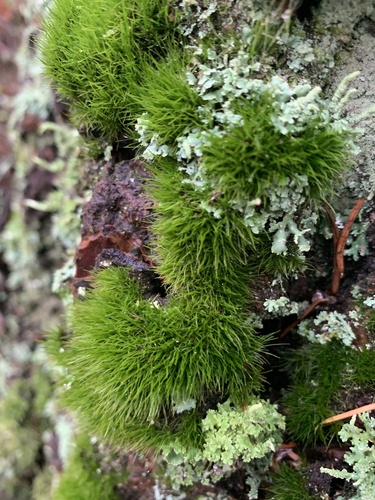
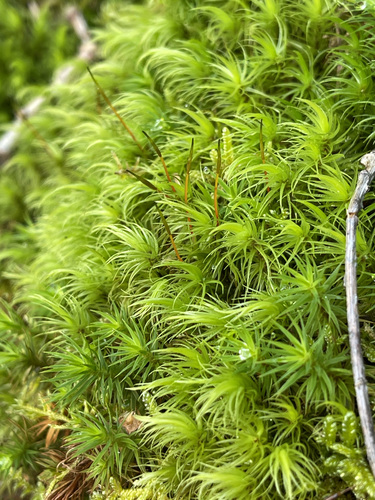
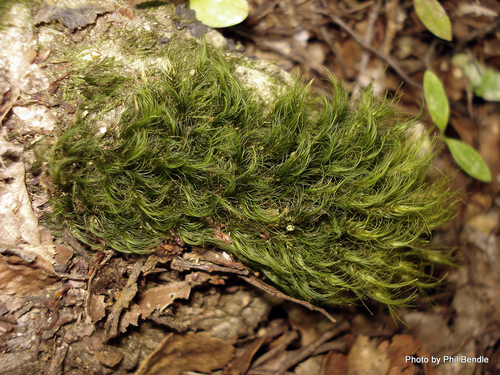
Plants of Dicranoloma menziesii are small to robust, growing 2.5–10 cm (1.0–3.9 in) tall. They are yellowish to dark green, and form tufts or cushions on growing substrates. Their rhizoids are pale brown to white, with a central strand present. The leaves are thin and long, and are either falcate-secund or wide-spread, forming a bristle-like structure at the tip. The upper half of the leaf is made up primarily of the leaf nerve, which extends past the leaf tip, and only contains one to three cell rows of lamina. These lamina cells are distinctive and isometric. The epidermis is differentiated on both the abaxial and adaxial sides, with distinct luminal cells. The broad costa of Dicranoloma menziesii distinguishes it from other closely related species, as it occupies almost the entire width of the median and upper parts of the leaf. Additionally, the species has rather short setae that are 10 mm (3⁄8 in) long or less. The capsules are cylindrical and may be slightly curved, and the setae range from 4.5–8 mm (3⁄16–5⁄16 in) long. Vegetative or perichaetial leaves often extend past the capsules. Peristome teeth are asymmetrically bifid, and one to two sporogones develop per perichaetium. Dicranoloma menziesii grows as loose turfs or clumps, mostly in wet forests at altitudes up to approximately 1,550 m (5,090 ft). It grows on substrates including tree stumps, rocks, logs, and lower tree bases and stems. It occurs across eastern Queensland, is widespread along the coast of New South Wales extending into Victoria, and is widespread across most of Tasmania and King Island. The species is also widespread throughout New Zealand and many of its surrounding islands. Within a single locality, D. menziesii may show a light form or a dark form, with intermediate forms being common. The lighter form has fewer chloroplasts than the darker form, and typically grows in more exposed habitats. Like many other bryophyte species, D. menziesii is an important pioneer species on bare surfaces. It converts unfavorable substrates into surfaces suitable for seedling germination, a process that is critical for the regeneration of some vascular plant species or communities. This is particularly important in habitats where forest floor herbivory or unsuitable light conditions prevent seedling establishment. Bryophytes like D. menziesii also act like sponges, absorbing water directly through their leaves and holding large volumes of water via surface tension between their leaves and fine shoots. Their presence also reduces soil erosion and water evaporation from soil, helping maintain a stable environment for other organisms.