About Dicranoloma billardieri (Brid.) Paris
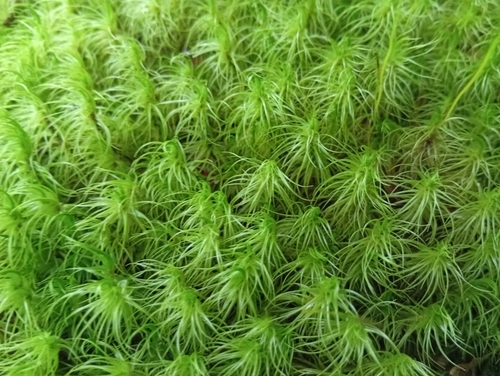
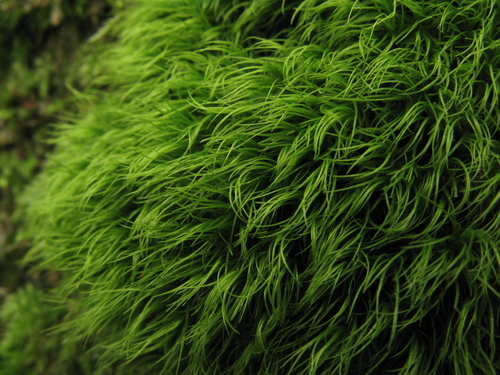
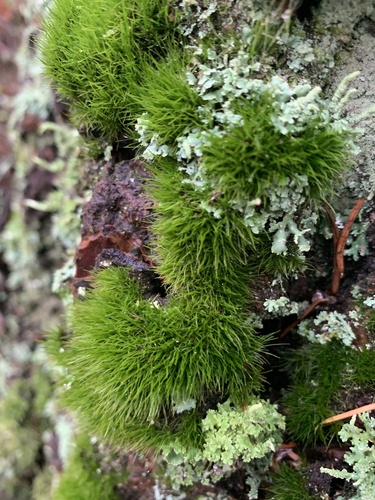
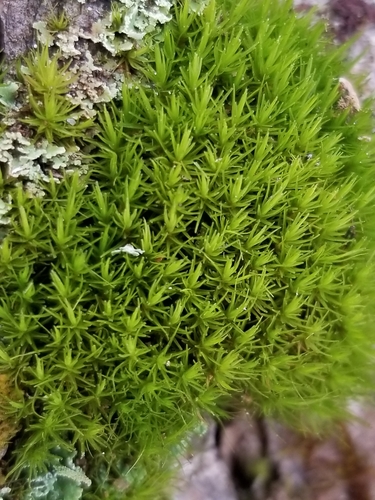
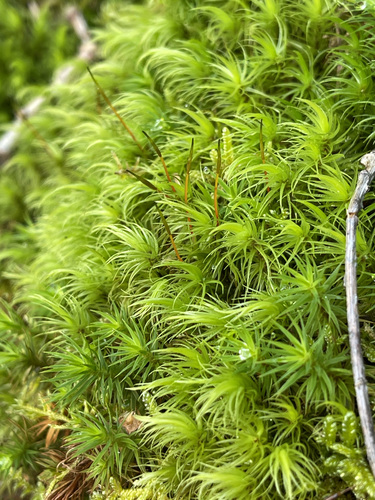
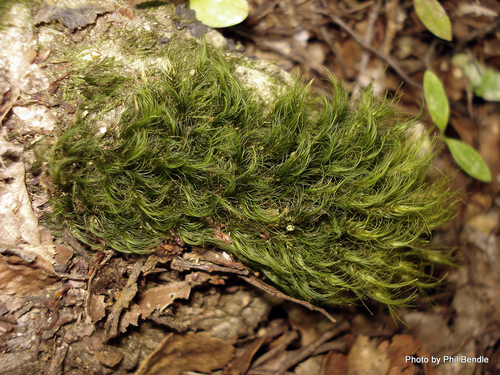
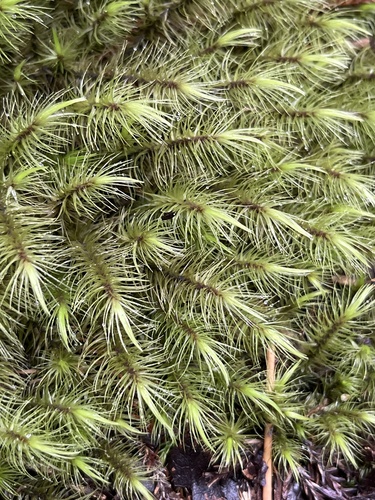
Dicranoloma billardieri is a moss with a lustrous green or golden-brown color, and it most often forms cushions up to 80 cm (31 in) in diameter. Its stems branch via innovation and forking. In cross-section, stems have 3 to 4 layers of cortical cells and a central strand, with rhizoids present in leaf axils. When fresh, its leaves are often twisted at the apex, and are either falcate or erect-spreading. Leaf margins are plane, entire below the apex, and either serrate or entire above the apex. Mid laminal cells are elongate and irregular, with elongate cells extending all the way to the leaf apex. The leaf border is well defined, and extends from the alar cell group to the leaf serrations. Cells at the base of the leaf are typically longer than other leaf cells. The costa is narrow, and wider at the middle of the leaf, with short spines growing on its abaxial surface. There is usually one seta per perichaetium; capsules are exserted and strongly curved. The operculum is curved, and the calyptra is cucullate and smooth. This species is very similar to Dicranoloma robustum, but can be distinguished by its more untidy leaf arrangement and generally smaller leaves. Dicranoloma billardieri is almost always paler, and less yellow, than D. robustum. Its extensively branched, often prostrate stems are visible within the leaf mass, and its short leaves make this moss very distinctive. The obtuse shape of its leaves is easily visible under a hand lens, and this is another identifying feature of the species. It can also be confused with Dicranoloma fasciatum, but D. billardieri has serrate upper leaf margins, while D. fasciatum has spinose serrate margins. Dicranoloma billardieri grows in both epiphytic and terrestrial habitats. It is most commonly found growing on logs, stumps, exposed roots, soil, or rock. In terrestrial environments, it often occurs on well-drained sites in a wide range of forest and shrub types. It grows on the forest floor in mixed broadleaf forest and southern beech forest, and in New Zealand it is frequently found in manuka scrub environments. It often forms a mosaic growth pattern with Dicranoloma robustum, and occurs from sea level up to approximately 1,250 m (4,100 ft). Dicranoloma billardieri typically has a main stem with multiple lateral branches, and a perichaetium commonly forms at each apex. The perichaetium is a sheath of enveloping leaves that surrounds the moss's sex organs. Female sex organs (archegonia) begin development later than male sex organs (antheridia). Archegonia take approximately three months to mature, while antheridia take six to seven months. Mature antheridia are full-sized, and the leaves surrounding the antheridia become noticeably bulging. After an archegonium is fertilized, no further archegonial development is inhibited. When haploid gametes fuse, the male gamete from the antheridium fertilizes the female gamete in the archegonium, forming a diploid spore-producing structure called the sporophyte. Fertilization takes between two and three months in this species. Sporophytes grow in seta length and capsule size from March to July. By early spring, sporophytes reach the stage with an intact operculum, and begin rapid development. After spore dispersal is complete, only the seta remains to mark where the sporophyte grew, once the capsule is shed. Overall, sporophyte maturation takes approximately twenty months. Compared to species like Dicranoloma menziesii, Dicranoloma billardieri produces relatively few sporophyte colonies. Sporophytes do not resume development until the previous season's spores have been released. This reduces the nutritional demand placed on the gametophyte, which supports early-stage sporophyte development. Gametophytes of this species can support new sporophytes even while capsules from the previous year remain, because sporophytes produce some of their own energy requirements. Dicranoloma billardieri has a seasonal pattern of sporophyte development, while gametangial (gamete-producing) development occurs multiple times per year with some irregularity. This irregularity may be a result of unpredictable environmental conditions where the moss grows. Antheridia development in D. billardieri tends to occur later than in related species like D. menziesii; this may be because D. billardieri typically grows on decaying logs and in cool hollows protected by overhanging fronds. Timing of reproductive cycle events may be influenced by environmental factors including rainfall, light, and temperature, and is also likely genetically controlled. Many invertebrates are associated with mosses, which provide moist microhabitats. Mosses like this are ectohydric, meaning they conduct water externally, and absorb water across most of their surface. They can also retain water for long periods. In Dicranoloma species, water retention and uptake is improved by a covering of rhizoids on stems, and is also linked to growth form. Invertebrate communities contribute to ecosystem biodiversity, and mosses provide invertebrates with camouflage, protection, shelter, food, and a site to deposit eggs. Mosses in turn can benefit from invertebrates, which may assist with sperm dispersal. Invertebrates including mites are common on Dicranoloma stems, along with species of Gastropoda, Thysanoptera, and Coleoptera, all of which feed on the moss. Bacterial and algal remains, and dead decaying organic matter trapped within the moss also provide food for some invertebrate species.