About Dichrostachys cinerea (L.) Wight & Arn.
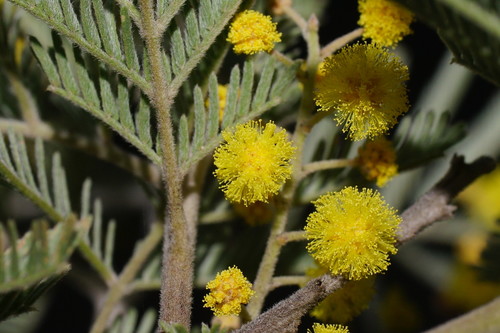
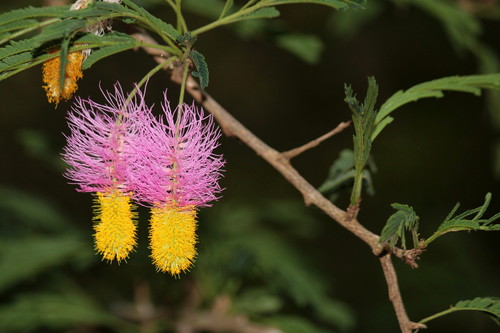
Dichrostachys cinerea (L.) Wight & Arn. typically grows up to 7 metres (23 ft) tall, with strong alternate thorns that are generally up to 8 cm (3.1 in) long. Its bipinnately compound leaves reach up to 15 centimetres (5.9 in) in length. The species has distinctive fragrant bicoloured cylindrical flower spikes that resemble Chinese lanterns, measuring 6 to 8 centimetres (2.4 to 3.1 in) long. The upper sterile flowers of a hanging spike are lilac or pale purple, while the lower half of the spike holds yellow flowers. Its pods are usually mustard-brown, twisted or spiralled, and may be up to 100 by 15 millimetres (3.94 in × 0.59 in). Two recognized subspecies are accepted: D. cinerea ssp. africana and D. cinerea ssp. nyassana; the latter is typically larger and has less hairy foliage. This species grows in drier forests and woodlands at altitudes up to 2,000 metres (6,600 ft), most often in areas with strong seasonal climate, across a wide range of mean annual temperatures, where mean annual rainfall falls between 200 to 400 millimetres (7.9 to 15.7 in). It can be found in brushwood, thickets, hedges, teak forest and grassland, and grows well in poorer quality clays, or deep sandy soils across a wide pH range. In India, it occurs in dry deciduous forest. In southern Africa, Dichrostachys cinerea generally flowers from October to February, and fruits from May to September. It grows at a medium to slow rate, adding 6 to 8 centimetres (2.4 to 3.1 in) of growth per year. Dichrostachys cinerea is native to Africa, the Indian subcontinent and North Australia, and has been introduced to the Caribbean and parts of Southeast Asia. In Ethiopia, the species is common in Nechisar National Park. It was brought to the Caribbean in the 19th century. In countries such as Namibia, it is considered a dominant species of woody plant encroachment. In Cuba, where it is called El Marabú or Marabou weed, it has become a serious invasive species, occupying around 4,900,000 acres (20,000 km2) of agricultural land; plans are currently underway to use it as a source of biomass for renewable power generation. It has also been observed in peninsular Florida, and it is not yet certain whether it was introduced by humans or birds. The fruit and seeds of Dichrostachys cinerea are edible. Cattle, camels, and game animals including giraffe, buffalo, kudu, hartebeest, nyala, red forest duiker and Damara dik-dik feed on the juicy pods that fall to the ground. These animals also feed on the species' immature twigs and leaves, which are rich in 11–15% protein and minerals. The flowers are a valuable source of nectar for honey production. The dense wood burns slowly and is non-toxic, so it is commonly used for fuelwood. The species produces a medium to heavy, durable hardwood that is often used for small domestic items such as walking sticks, tool handles, spear handles, particularly in central Africa. While there is currently limited to no evidence to support these uses, the bark is used in traditional medicine to treat headache, toothache, dysentery and elephantiasis. Root infusions are used to treat leprosy and syphilis, to relieve coughs, and used as an anthelmintic, purgative, and strong diuretic. Leaves are used to treat epilepsy, and also used as a diuretic and laxative. A powdered preparation of the plant is massaged onto limbs with bone fractures, and the roots are sometimes used to treat bites or stings. In Siddha medicine practiced by Tamil people in southern India, Dichrostachys cinerea is called vidathther, and used to treat gonorrhea, syphilis and eczema. Because the plant is rich in nutrients, it is often used as fertiliser, especially in the Sahel region of Africa along riverbanks. It is also widely used for soil conservation, in particular for shallow soils in India, and on arid western and subhumid alluvial plains. It is popularly cultivated as an indoor bonsai specimen. Despite its many uses, it is generally regarded as a threat to agricultural production and is listed on the Global Invasive Species Database.