About Dichondra repens J.R.Forst. & G.Forst.
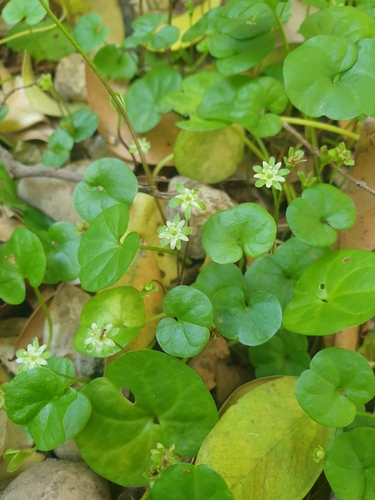
Dichondra repens J.R.Forst. & G.Forst. is a perennial herb with a creeping growth habit, forming roots at its nodes. Its leaves range from kidney-shaped to circular, typically 5–25 mm long and 5–30 mm wide, growing on a 10–50 mm long petiole. The base of each leaf is heart-shaped, and the leaf apex is round or slightly notched. Both leaf surfaces are covered in soft, greyish hairs. Flowers grow singly on a pedicel that is usually 5–60 mm long. The sepals are joined at the base, with lobes 2.5–4 mm long. The petals are pale greenish-yellow, joined at the base to form a short tube, with lobes roughly the same length as the sepal lobes. Flowering occurs year-round, with a peak in spring and summer: it flowers most profusely from September to February, with the highest peak in November. The fruit is a hairy, two-lobed capsule. This species, commonly called kidney weed, is widespread across all Australian states and New Zealand, and also grows on the Indian Ocean islands of Mauritius, Réunion and Rodrigues. It inhabits forest, woodland, and grassland on clay or clay-based soils with medium to high nutrient levels, and is known as a lawn weed. In New South Wales, its common associated species include river peppermint (Eucalyptus elata), thin-leaved stringybark (Eucalyptus eugenioides), woollybutt (Eucalyptus longifolia) and snow-in-summer (Melaleuca linariifolia). Ecologically, the native Pacific black duck (Anas superciliosa) feeds on the seeds of Dichondra repens. In horticulture, the species is cultivated as an ornamental plant, and can be used as a lawn substitute or garden groundcover.