About Dichomeris vacciniella Busck, 1915
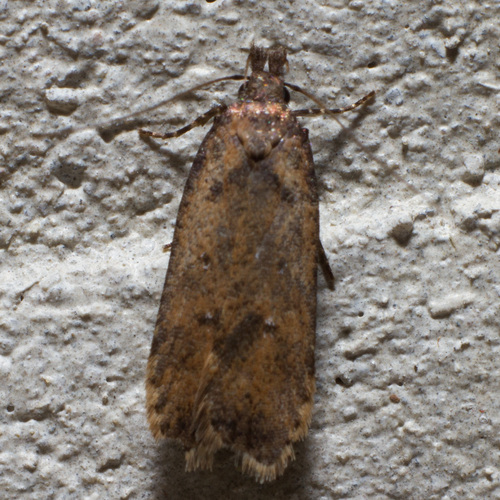
Dichomeris vacciniella is a species of moth that belongs to the family Gelechiidae. This species was first described by August Busck in 1915. It is native to North America, with confirmed records spanning from Nova Scotia, southern Quebec, and southern Ontario south to Florida, Michigan, Missouri, and Arkansas. This moth has a wingspan of 15 to 17 millimeters. Its forewings are dark brown, sparsely and irregularly dusted with black scales. They bear three small, round black dots each edged with white scales: one at the middle of the cell, one obliquely below and before the first dot on the fold, and one at the end of the cell. The apical region of the forewing is strongly suffused with purplish black scales, and the very edge of the apex and terminal margin is black. The hindwings are light fuscous, with black suffusion on the outer costal portion. Adult moths can be found in flight from February through October. The larvae of this moth feed on plant species from the genus Vaccinium, including Vaccinium macrocarpon and Vaccinium pallidum.