About Dichocoenia stokesii (Milne Edwards & Haime, 1849)
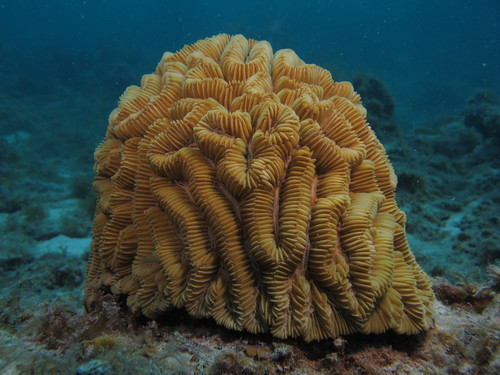
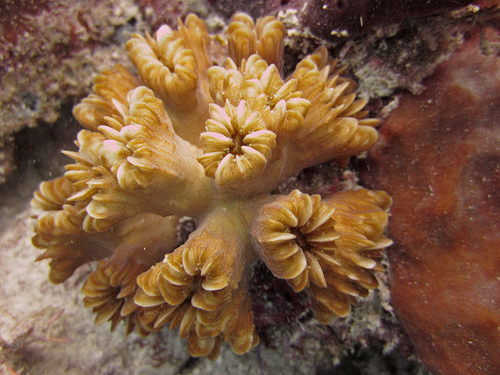
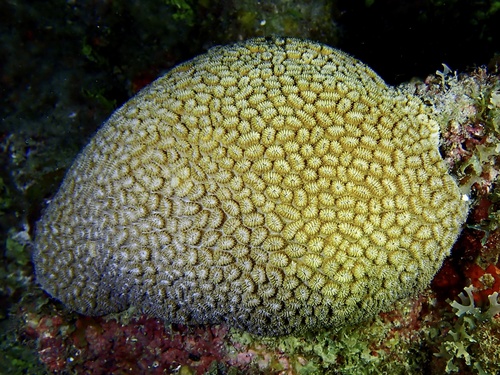
Dichocoenia stokesii (sometimes written as D. stokesi) is a massive colonial stony coral. It forms rounded humps up to 40 centimetres (16 inches) in diameter, or thick plates. This coral can be identified by the varied shape of its corallites — the stony cups that coral polyps protrude from. Many corallites are oval or elongated, reaching up to 5 centimetres (2.0 inches) long and only 0.5 centimetres (0.20 inches) wide. Other corallites are circular or Y-shaped, and all corallites have raised rims. The columella, the central axial structure inside each corallite, is fragile and spongy. The coral's polyps are large, well-separated, and have a diameter of about 4 millimetres (0.16 inches). Its overall colour is variable, and may be white, cream, orange, yellowish-brown, green, olive, or brown. The septo-costae, the small ridges that surround the corallites, are always white. Sometimes two separate coral colonies grow alongside each other and intertwine to form a single combined hump, but they do not fuse their tissues, and each retains its original individual colour. Dichocoenia stokesii is native to the western Atlantic Ocean and Caribbean Sea. Its range extends from Bermuda and southern Florida south to the southern half of the Gulf of Mexico, and along the Central American coast to Venezuela. Fossil evidence shows this species has been present in the Caribbean region since the Oligocene Era, between 34 and 23 million years ago. It is a relatively uncommon coral. It tends to grow on fore reefs and back reefs, and does not grow on reef crests. It has a broad depth range, from 2 to 72 metres (6 to 236 feet), but is most common at depths of 30 metres (98 feet) or less. Corallites are larger and more prominent in individual corals that grow at greater depths.