About Dichanthelium laxiflorum (Lam.) Gould
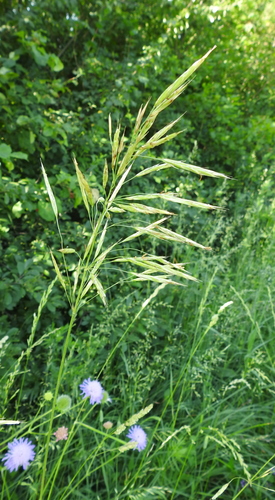
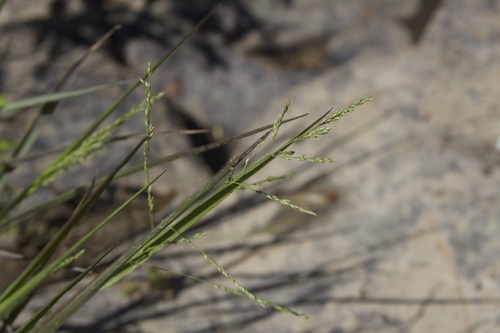
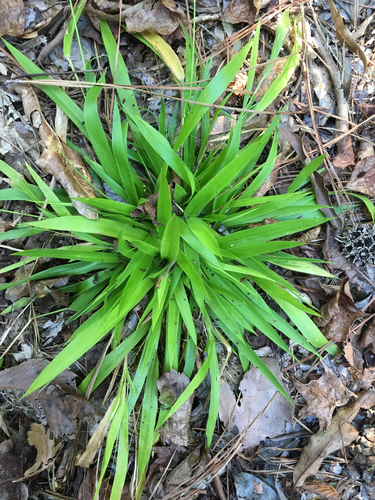
Dichanthelium laxiflorum is a tufted perennial grass species. Its culms reach 15 to 45 cm in height, and typically have bearded nodes; its internodes range from glabrous to slightly roughened. Most of its leaves grow on the lower portion of the stem; leaf blades can grow up to 16 cm long and 4 to 15 mm wide. The blades are generally glabrous or rough-textured, and sometimes have appressed to spreading soft hairs. Its ciliate ligules measure 0.5 to 1 mm long. The species produces a vernal panicle 4 to 9 cm long and 3 to 6 cm wide, with smooth or nearly smooth pedicels that measure 1 to 10 mm in length. Its spikelets are ellipsoid, and measure 1.6 to 2.3 mm long. The first glume is scarious, acute, either nerveless or single-nerved, and 1.6 to 2.3 mm long. The sterile palea is also scarious, and measures 1.2 to 1.6 mm. Fertile lemmas and paleas are hardened, usually nerveless or faintly nerved, lustrous, and yellowish to brownish, and measure 1.5 to 2 mm long. Its grains are broadly ellipsoid, 1 to 1.5 mm long, and whitish to yellowish. In the United States, this species ranges from Maryland south to Florida, west to Texas, and north to Indiana. It is also found in Mexico, Central America, and the West Indies. It grows in open or shaded woodlands, most often in moist soil.