About Diceros bicornis (Linnaeus, 1758)
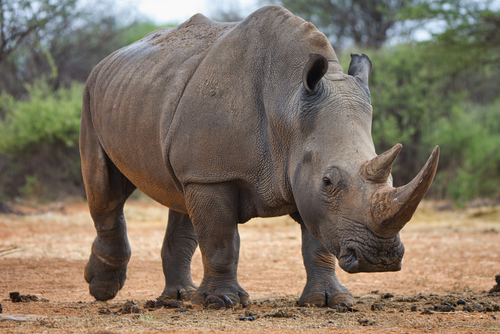
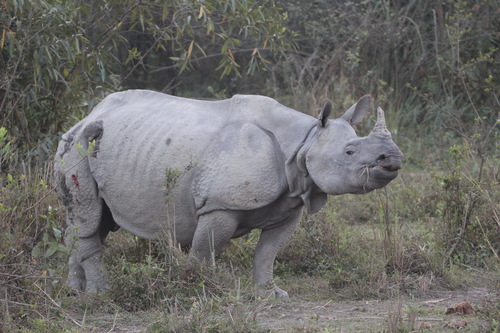
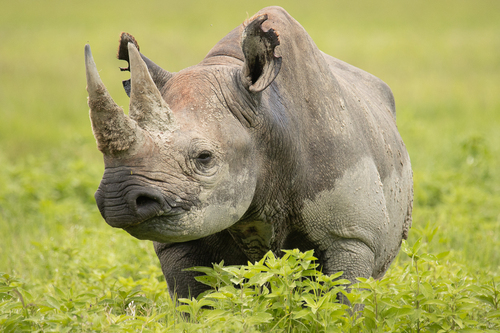
This species, the black rhinoceros, has the scientific name Diceros bicornis (Linnaeus, 1758). An adult black rhinoceros stands 1.32–1.8 m (4.3–5.9 ft) high at the shoulder and is 2.8–3.75 m (9.2–12.3 ft) in length. An adult typically weighs between 800 and 1,400 kg (1,800 to 3,100 lb), though unusually large male specimens have been recorded weighing up to 2.9 t (3.2 short tons). Female black rhinos (cows) are smaller than males (bulls). Black rhinos have two keratin horns on their skull; the larger front horn is typically 50 cm (1.6 ft) long, and can exceptionally reach 135.9 cm (4.5 ft). The longest known black rhinoceros horn measured nearly 1.5 m (4.9 ft) in length. In some cases, a third, smaller horn may develop. These horns are used for defense, intimidation, digging up roots, and breaking branches during feeding. The black rhino is smaller than the white rhino, and is close in size to Indonesia's Javan rhino. It has a pointed, prehensile upper lip that it uses to grasp leaves and twigs when feeding, in contrast to the white rhinoceros, which has square lips adapted for eating grass. Black rhinos can also be distinguished from white rhinos by their smaller overall size, smaller skull, and smaller ears, as well as the higher position at which they hold their head. This difference in head position exists because black rhinos are browsers, not grazers. Their thick-layered skin protects them from thorns and sharp grasses. Their skin hosts external parasites such as mites and ticks, which may be eaten by oxpeckers and egrets. This relationship was originally thought to be an example of mutualism, but recent evidence suggests oxpeckers may instead be parasites that feed on rhino blood. It is commonly assumed that black rhinos have poor eyesight, and rely more heavily on hearing and smell. However, studies have shown their eyesight is comparatively good, around the same level as a rabbit's. Their ears have a relatively wide rotational range to detect sounds, and an excellent sense of smell alerts rhinos to the presence of predators. Like many other African large mammal species, black rhinos likely had a wider prehistorical range in the northern part of the African continent than they do today. This prehistorical range does not appear to have been as extensive as that of the white rhino. Unambiguous fossil remains of black rhinos from northern prehistoric Africa have not yet been found, and the abundant petroglyphs across the Sahara Desert are often too schematic to clearly identify whether they depict black or white rhinos. Petroglyphs from the Eastern Desert of southeastern Egypt provide relatively convincing evidence that black rhinos occurred in this area during prehistoric times. The natural historical range of the black rhino covered most of southern and eastern Africa, with the exception of the Congo Basin, the tropical rainforest areas along the Bight of Benin, the Ethiopian Highlands, and the Horn of Africa. It remains uncertain whether black rhinos were originally native to the extremely dry parts of the Kalahari Desert in southwestern Botswana and northwestern South Africa. They were once abundant across an area stretching from Eritrea and Sudan through South Sudan to southeastern Niger, especially around Lake Chad. Their occurrence further west is questionable, despite frequent claims of it in academic literature. Today, black rhinos are only found in protected nature reserves, and have disappeared from many countries where they once thrived, particularly in the west and north of their former range. Remaining black rhino populations are highly scattered. Some individual black rhinos have been moved from their original habitat to better protected locations, sometimes across national borders. Black rhinos have been successfully reintroduced to Malawi starting in 1993, after the species went extinct there in 1990. They were similarly reintroduced to Zambia's North Luangwa National Park in 2008, after going extinct in Zambia in 1998, and to Botswana in 2003, after going extinct in Botswana in 1992. In May 2017, 18 eastern black rhinos were moved from South Africa to Akagera National Park in Rwanda. Akagera National Park had around 50 rhinos in the 1970s, but the population declined to zero by 2007. In September 2017, the birth of a calf brought the park's black rhino population to 19, and the park maintains dedicated rhino monitoring teams to protect the animals from poaching. In October 2017, the governments of Chad and South Africa reached an agreement to transfer six black rhinos from South Africa to Zakouma National Park in Chad. Once the population is established, it will be the northernmost population of the species. The species was eradicated from Chad in the 1970s, and black rhinos face severe poaching pressure in South Africa. The agreement requires South African experts to assess the habitat, local management capabilities, security, and infrastructure before the transfer can take place. Adult black rhinos are solitary, and only come together to mate. Mating does not follow a seasonal pattern, but births tend to occur near the end of the rainy season in more arid environments. When a female is in breeding season, she marks dung piles. Males will follow females that are in season; when a female defecates, the following male will scrape and spread the dung, which makes it harder for rival adult males to pick up her scent trail. Courtship behaviors before mating include snorting and horn sparring between males. Another courtship behavior is called bluff and bluster, where a black rhino will snort and swing its head aggressively from side to side before repeatedly running away. Breeding pairs stay together for 2–3 days, and sometimes for even several weeks. They mate several times a day over this period, and copulation lasts for a half-hour, or can even last longer than one hour. The gestation period for a black rhino is 15 months. A single calf is born, which weighs around 35–50 kilograms (80–110 lb) at birth, and can follow its mother just three days after birth. Offspring are weaned at around 2 years of age. Mothers and calves stay together for 2–3 years, until the next calf is born; female calves may stay longer, forming small groups. Young black rhinos are occasionally preyed on by hyenas and lions. Females reach sexual maturity between 5 and 7 years old, while males reach sexual maturity between 7 and 8 years old. The life expectancy of black rhinos in natural conditions without poaching pressure is 35 to 50 years. The oldest known black rhinoceros was Fausta, who lived to 57 years old.