About Dicaeum trochileum (Sparrman, 1789)
Scientific name: Dicaeum trochileum (Sparrman, 1789)
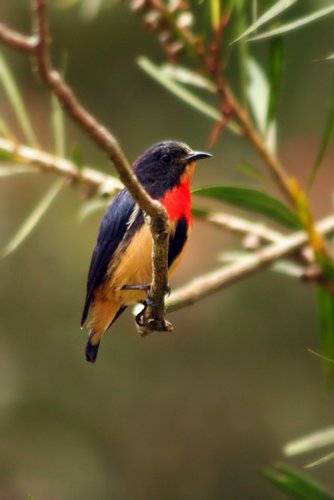
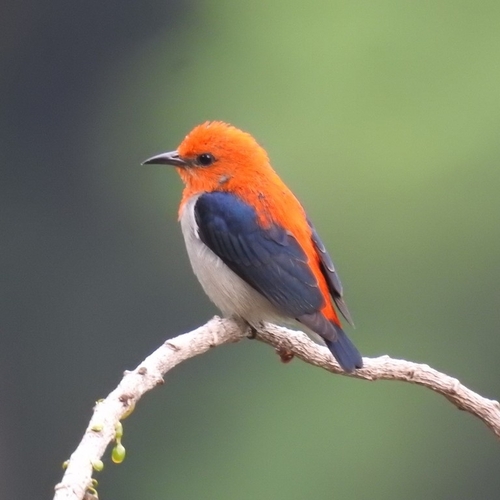
When mature, scarlet-headed flowerpeckers reach a body length of eight to nine centimeters. Males can be easily distinguished from females by their red to orange upper bodies. Male red plumage covers the head, back, rump, and throat; their wings are black with blue pigmentation, legs are black, beak is grey, and the tail tip is black.
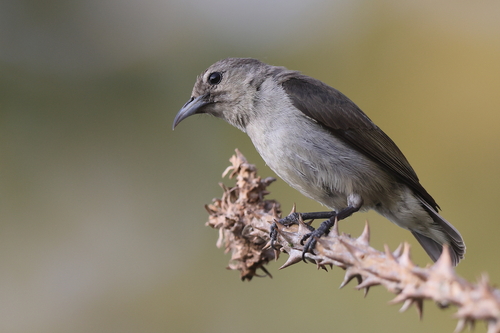
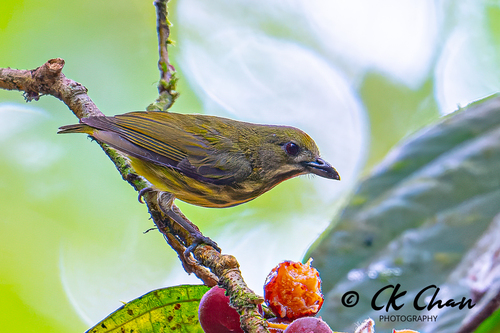
Females have light grey to brown heads and backs, and are characterized by their orange to red rumps. Like males, females have black legs, a grey beak, and a black tail tip. Their wings are lighter in color than males' wings and lack blue pigmentation.
Juveniles have a morphology that more closely resembles females than males. Young birds are characterized by their small size and lighter body colors. They have a light grey beak, pale brown wings, and a pale grey to yellow belly.
This species is endemic to several islands of the Indonesian archipelago. It mainly inhabits the islands of Java and Bali, with a small number of individuals reported on Lombok, Sumatra, and in southeastern Borneo. It mostly lives in open woodlands, gardens, and mangroves, and has also been reported on seacoasts and in the lowlands of Sumatra Island. It occurs from sea level up to a maximum altitude of 600 meters. Many tourists travel to the Taro region of Bali to observe this bird.
For reproduction, this species builds nests measuring approximately 70–80 × 30–35 mm, constructed from grass, leaves, and milkweed fibers. Its eggs are white, sometimes glossy, with a dark red spot at one end. The flowerpecker lays its eggs in a large hole dug in the center of the nest. Both males and females remain in the nest to care for their chicks together.