About Dicaeum trigonostigma (Scopoli, 1786)
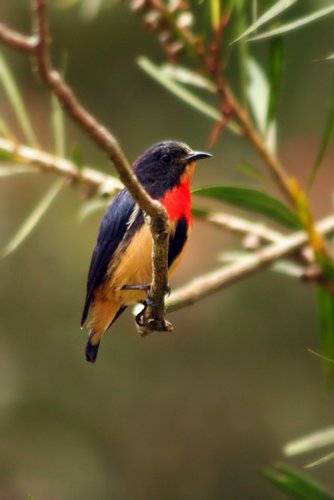
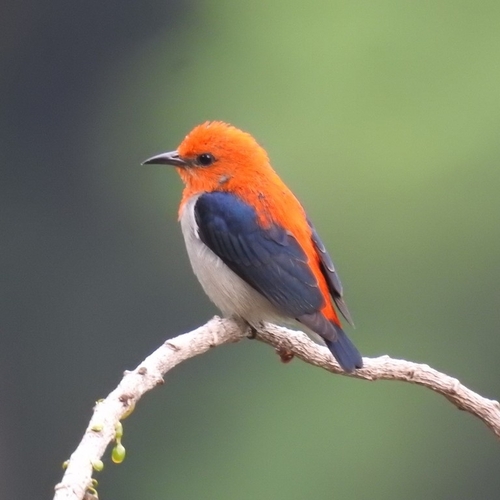
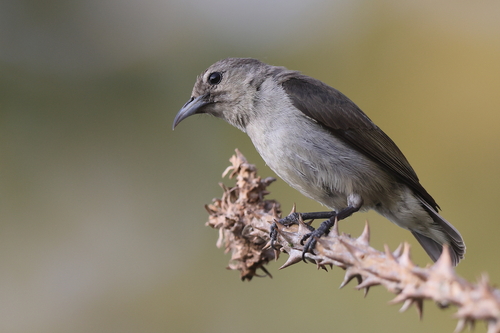
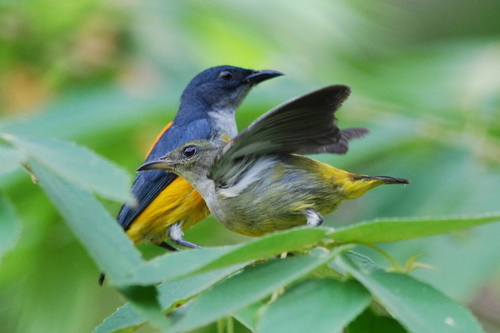
This species has the scientific name Dicaeum trigonostigma (Scopoli, 1786). Males are highly distinctive. Their upperparts, including the crown, nape, wings, and tail, are slaty-blue, with the exception of a large triangular orange patch on the mantle. They have a fairly thin, short bill that is slightly curved downward at the tip. The throat and upper breast are a lighter greyish blue. From the lower breast to the vent, color shifts in a gradient from fiery orange on the lower breast to yellow on the vent. Females are much duller overall. They are mostly drab olive brown across the body, with the only exceptions being a pale orange rump and a yellow belly. In 1947, Delacour cited the name Dicaeum trigonostigma melanostigma in his Birds of Malaysia. However, the name was published as a nomen nudum, because it was not accompanied by a description, and no type specimen was identified. Delacour later stated in private correspondence that the name was a lapsus, as noted by Salomonsen in American Mus. Novitates No. 1991 (1960). Despite this, the name Dicaeum trigonostigma melanostigma continued to be cited in various works including the 1980 and 1991 editions of Howard and Moore's Complete Checklist of the Birds of the World, and on websites that list birds found in Thailand and the surrounding region. This could potentially lead to the inadvertent validation of the name if any published reference to it is paired with an image of an orange-bellied flowerpecker. In the 2003 Complete Howard and Moore Checklist, Dickinson also asserted that the name was a lapsus, but attributed the error to Howard and Moore rather than Delacour. The natural habitats of Dicaeum trigonostigma are subtropical or tropical moist lowland forest, subtropical or tropical mangrove forest, and subtropical or tropical moist montane forest.