About Dicaeum monticolum Sharpe, 1887
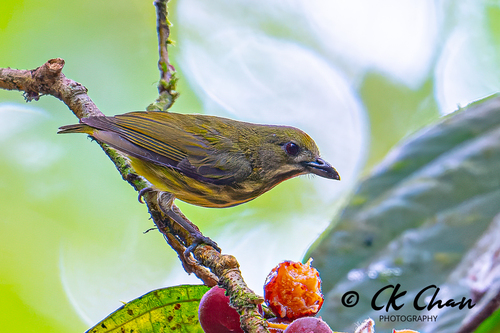
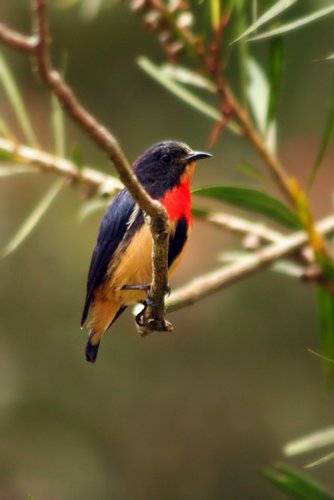
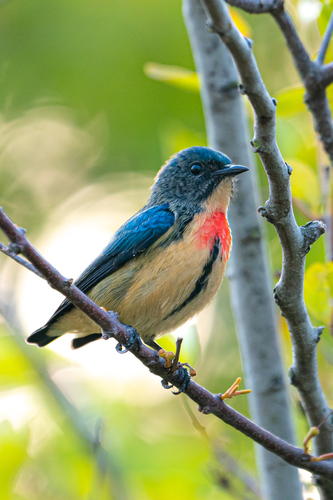
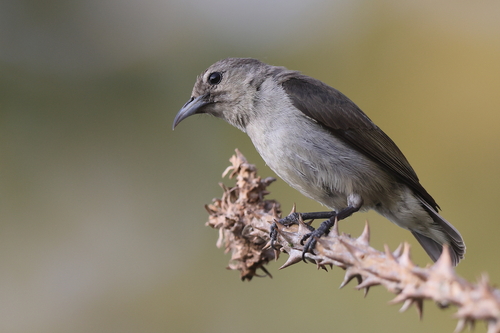
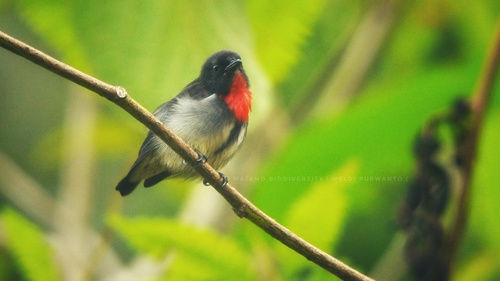
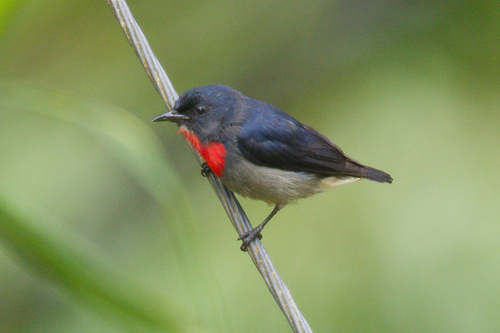
The black-sided flowerpecker (scientific name Dicaeum monticolum Sharpe, 1887) is a very small passerine bird that measures only 8 cm (3.1 in) in length; its weight has never been recorded. Like many other flowerpeckers, this species shows sexual dimorphism, with males being far more colorful than females. Males have glossy blue-black upperparts. Their face and the sides of the neck are black, the chin is white, and they have a scarlet throat and breast outlined by a greyish-black border. Their upper flanks and upper belly are dark grey, lower flanks are olive, and the lower belly is white. The vent and undertail coverts are buffy-yellow, while underwing coverts and pectoral tufts are both white. Females have olive-green upperparts and greyish underparts, with buffy flanks, a yellowish rump, a whitish throat, and white pectoral tufts. Immature birds resemble adult females, but have more olive-grey underparts. They have fine dark streaking running from the chin to the breast, and immature males may already show some crimson coloring on the breast. Both sexes have dark brown irises, black bills, and feet that are described as either brown or dark grey. This flowerpecker is endemic to the montane forests of Borneo. It is most commonly found at elevations above 1,000 m (3,300 ft), and has been recorded as high as 2,540 m (8,330 ft) in some areas. It can descend as low as 460 m (1,510 ft) on Borneo's two largest mountains, Kinabalu and Mount Trus Madi. Far more records of this species exist from the Malaysian states of Sabah and Sarawak than from the Indonesian provinces of Kalimantan. It inhabits primary forest, secondary forest, kerangas heathland forest, scrub, and gardens. No seasonal or altitudinal movements are known to occur for the black-sided flowerpecker.