About Dicaeum ignipectus (Blyth, 1843)
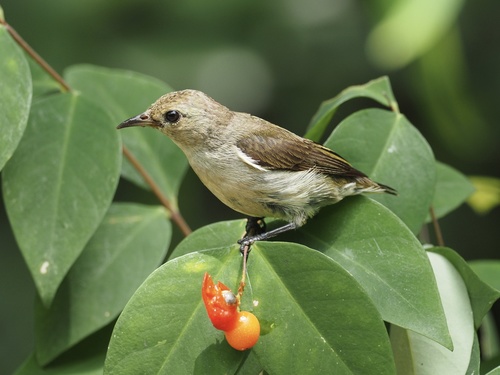
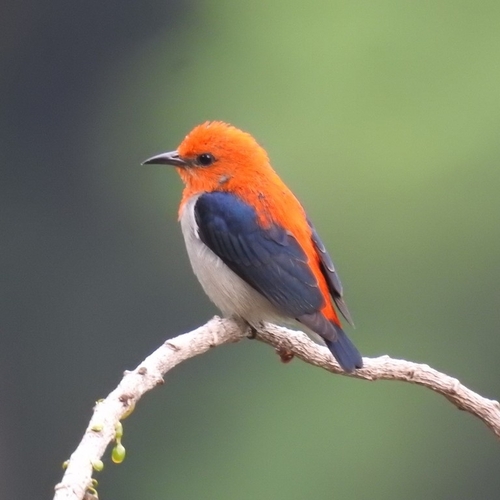
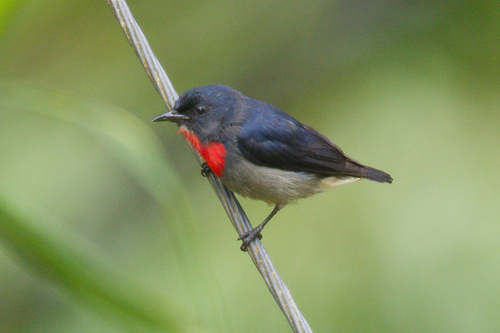
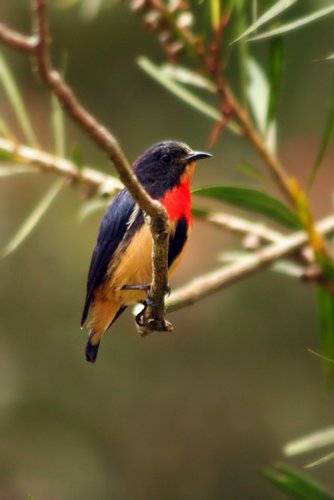
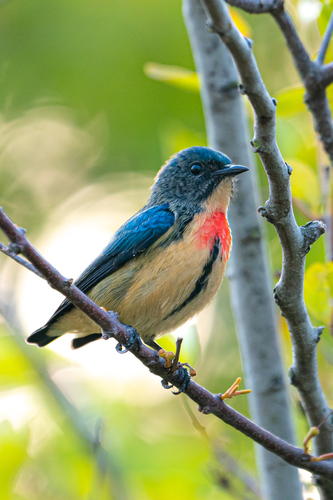
The fire-breasted flowerpecker, scientifically named Dicaeum ignipectus (Blyth, 1843), is a very small flowerpecker species with a small, dark bill. Males have glossy blue-black upperparts, buffy underparts, a bright red breast patch, and a short black stripe that runs from below the red patch down the center of the underside to the belly. Females have dark olive upperparts, buff underparts, olive-colored sides, and a bill with a pale base. Weighing only 7–9 g (0.25–0.32 oz) and measuring less than 7 cm (2.8 in) in length, it is one of the smallest flowerpecker species. It has been historically called the smallest bird of India, or possibly the smallest, with early notes stating an adult specimen was barely two and a half inches in total length and weighed only three and a half drachms.
This species typically occurs at the tops of trees, especially on mistletoes, and keeps itself well out of sight. It regularly produces a shrill call that has been compared to the sound of snipping scissors, described as a staccato tsit. Edward Blyth first formally described the species in 1843, using a specimen collected from Nepal by B. H. Hodgson. The species name originated from Hodgson’s manuscripts, but was published by Blyth. The type specimen, reportedly deposited at the British Museum, is considered lost, though it may still exist in the collection of the Asiatic Society museum in Calcutta.
It is widely distributed across the sub-Himalayan region of India, Nepal, Bhutan, and Bangladesh, and extends further into Southeast Asia to reach Indonesia, Laos, Thailand, Vietnam, Taiwan, Malaysia, and the Philippines. Its natural habitats are temperate forest, subtropical or tropical moist lowland forest, and subtropical or tropical moist montane forest. Across most of its range, it occurs in high mountains above 1000 metres, though in China it can be found at lower altitudes during winter.
Several distinct populations have been named as subspecies. The nominate subspecies D. i. ignipectus occurs from the Himalayas into mainland Southeast Asia. The remaining subspecies are insular populations: formosum from Taiwan, luzoniense from Luzon, bonga from Samar, and apo from Negros and Mindanao. The Sumatran subspecies beccarii is the most distinct form, differing also from the closely related Dicaeum sanguinolentum: male D. i. beccarii have a steel-green gloss on their upperparts and lack a throat patch, while females have greenish upperparts and lack a red rump. Populations in the Philippines have males with underparts similar to Dicaeum monticolum, while females have a steel-green gloss on their upperparts, unlike the dull green of more northern populations.
The species forms a superspecies complex with Dicaeum monticolum, D. celebicum, D. sanguinolentum, and D. hirundinaceum, and all these taxa are sometimes treated as a single species. Hybridization with Dicaeum cruentatum has been suggested. Many island forms have very restricted ranges or micro-endemism, so researchers note that these populations require careful consideration in conservation planning.
In behaviour and ecology, the fire-breasted flowerpecker disperses the seeds of mistletoes, like many other flowerpecker species. In the Nepal Himalayas, it is an important disperser of Scurrula mistletoe species. In Nainital, breeding occurs in June and July. The nest is a pendant, purse-like structure that opens on the side near the top. The thin, felt-like nest is constructed from the hairy stem coverings of mistletoes, and lined with moss and soft grass. Females lay two or three eggs, and both sexes incubate the eggs and care for the young. In Hong Kong, the species’ population is believed to have increased as restored forests have matured. It was first recorded in Hong Kong in 1954, and has bred regularly there since 1975.