About Dicaeum hirundinaceum (Shaw, 1792)
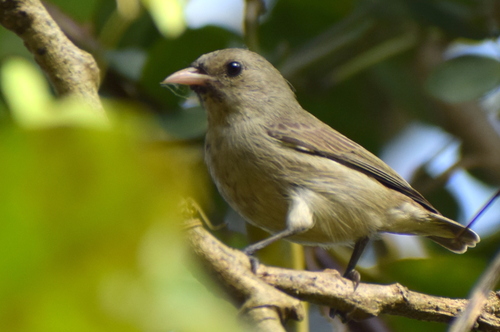
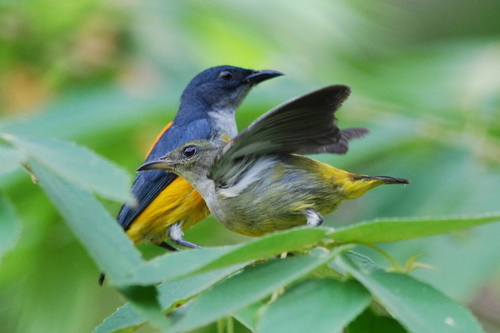
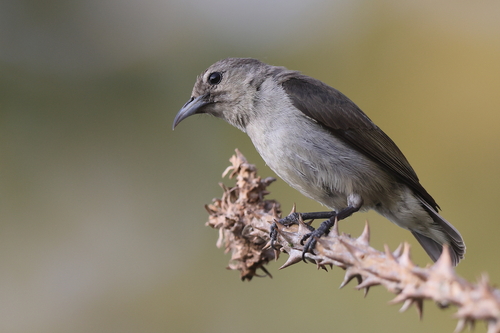
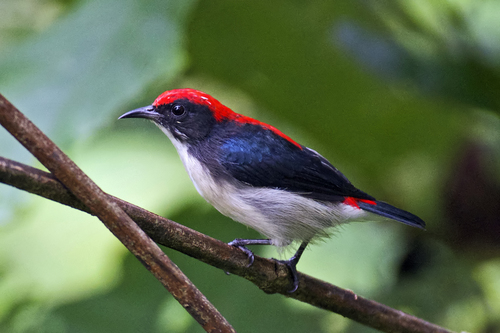
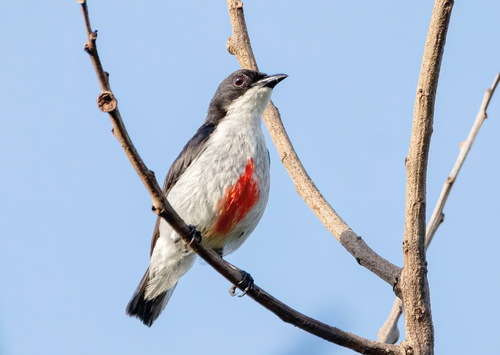
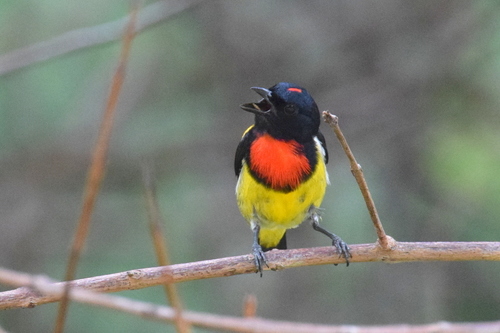
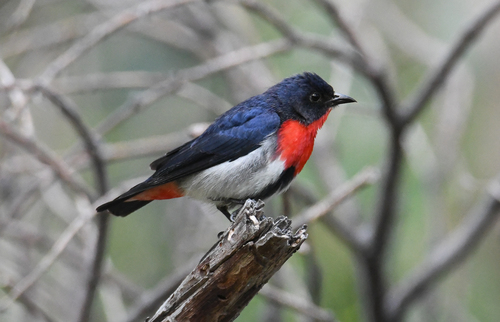
The mistletoebird, scientific name Dicaeum hirundinaceum (Shaw, 1792), is a small bird. It measures 9–10 cm (3.5–3.9 in) long and weighs 7.5–11 g (0.26–0.39 oz). Males are glossy blue-black above, with a red chest, a faint red patch under the tail, and a black central stripe running down a white belly. Females are dark grey above, with a white throat, light grey underparts, and just a faint pinkish-red patch under the tail. All adults have black eyes, bill, and legs; the bill is just over a centimetre long, slender, slightly down-curved, and sharply pointed. Immature birds resemble adult females, but have an orange-pink bill instead of black. Size and colour vary across the species' distribution: adult mistletoebirds are smaller in the northern part of their range, and northern females have lighter-coloured underparts than darker southern females. This species has long pointed wings and a short square tail with a slight notch at the tip. Mistletoebirds usually occur alone or in pairs, but occasionally gather in small family groups or flocks, and very rarely join mixed-species flocks when food is abundant. Their flight is swift, and they are usually seen flying above or high in the tree canopy, identifiable by their distinctly pointed wings. When perched, they typically hold an upright posture, but shift to a more horizontal, swaying posture when alarmed. They make a variety of vocalizations; their most familiar call is a short, sharp, high-pitched tzew or dzee whistle, most often given while in flight. Perched birds produce a repeated whistled wissweet wissweet song. Male mistletoebirds can be mistaken for scarlet robins (Petroica boodang) or flame robins (Petroica phoenicea), but they lack a forehead spot and have a black streak on the white belly. The combination of size, shape, behaviour, and plumage makes mistletoebirds unlikely to be confused with any other Australian passerine, though pardalotes and thornbills are the closest in size and shape. A documented record of mistletoebird longevity comes from southern Queensland, where a banded adult male was recaptured near its original banding site after nine years. Both sexes of mistletoebird vocalize like other bird species year round; they have been recorded mimicking the mulga parrot (Psephotus varius), as well as more than 25 different passerine species. Known predators that take mistletoebird nestlings include the grey shrike-thrush (Colluricincla harmonica), pied butcherbird (Cracticus nigrogularis), pied currawong (Strepera graculina), and the Australian raven (Corvus coronoides). Mistletoebird nests are also parasitized by multiple cuckoo species, including Horsfield's bronze-cuckoo (Chrysococcyx basalis) and the fan-tailed cuckoo (Cacomantis flabelliformis). Mistletoebirds are nomadic, with most movement being local and tied to the fruiting of mistletoe. They mostly live in forests and woodlands dominated by any Eucalyptus species, ranging from dry interior areas to coastal rain forests, but do not frequent high altitude areas in winter, as they enter a torpid state when cold. They are more likely to live in mature stands with larger trees, which are more likely to have mistletoe infestations, than in regenerated areas. There are over 1300 mistletoe species worldwide, and about 100 in Australia; a common variety in drier Australian climates is grey mistletoe (Amyema quandang). All mistletoes share a common growth form: they get water and nutrients from their host tree via a specialized vascular attachment, but make their own carbohydrates through photosynthesis, so they are called half parasitic. Mistletoebirds are common on mainland Australia, but there are no mistletoes in Tasmania. Less specialized fruit-eating species such as honeyeaters get most of their protein from arthropods, and travel far to find these prey, making them long-distance dispersers of mistletoe seeds. In contrast, mistletoebirds generally focus and limit their feeding to local mistletoe infestations. Recent ecological studies have found that mistletoe supports rich biodiversity in areas where it grows abundantly. Leaf litter from mistletoe infestations, which comes from a high turnover of nutrient-rich mistletoe leaves, supports diverse animal and plant life. The dense growth of mistletoe bushes and the characteristics of their leaves also make them cool, safe places for birds to rest, hide, and nest. A recent study in southern Australia reported that 217 species of Australian arboreal birds nest in mistletoe, including the mistletoebird.