About Dicaeum erythrorhynchos (Latham, 1790)
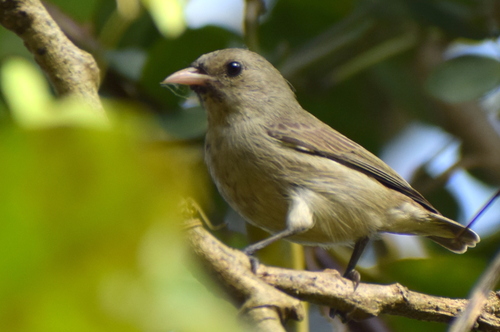
This species is a tiny bird with a scientific name of Dicaeum erythrorhynchos (Latham, 1790). It reaches 8 cm in length, and is one of the smallest bird species found across most of southern India and Sri Lanka. Its plumage ranges from plain brownish to olive green. The underside is buff olive, and does not contrast strongly with the upperparts. Unlike the Nilgiri flowerpecker of the Western Ghats and Nilgiri hills, this species does not have a whitish underside; unlike the thick-billed flowerpecker, it does not have streaked underside plumage. The Nilgiri flowerpecker has a pale supercilium, while this species has no markings on its head. The Sri Lankan subspecies ceylonense Babault, 1920 is greyer and smaller than the nominate subspecies native to peninsular India. This species is thought to be one of the early flowerpeckers originating in the Malay Peninsula that colonized the Indian Subcontinent. In forested habitats, these birds frequently visit flowers of Loranthus (now classified as Dendrophthoe) and Viscum species. Seeds from these plants are primarily dispersed by this species and other flowerpecker species. The berries produced by these epiphytic parasites are usually swallowed whole. Individuals may sometimes pinch fruits, discard seeds, and feed only on the pulp, but this feeding behavior is more commonly used by the syntopic thick-billed flowerpecker. After swallowing, seeds pass rapidly through the bird's gut and are voided in approximately three to four minutes. Voided seeds have a sticky coating. To remove the seed, the bird presses its vent against the surface of a suitable perch and may turn around, leaving the seed stuck to the branch where it can later germinate. This species acts as a pollinator for the flowers of Dendrophthoe falcata. When the bird nips the tip of the species' flower bud, a bud mechanism releases pollen that explosively sprays onto the bird's plumage. In urban areas, this bird is particularly attracted to introduced fruit trees such as Muntingia calabura. It may swallow the tree's fruits whole, or crush ripe berries to access the pulp using its tongue. It also sips nectar from the flowers of species including Sterculia colorata and Woodfordia floribunda, and pollinates these flowers in the process.