About Dicaeum concolor Jerdon, 1840
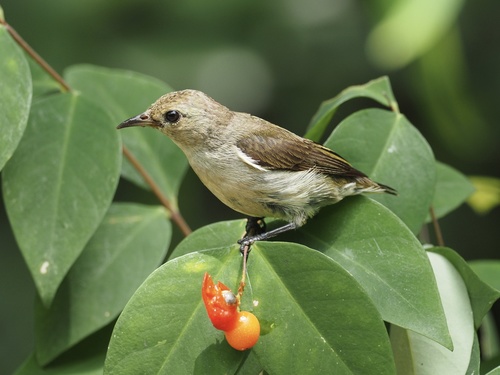
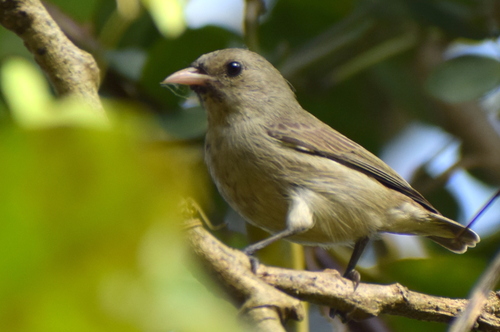
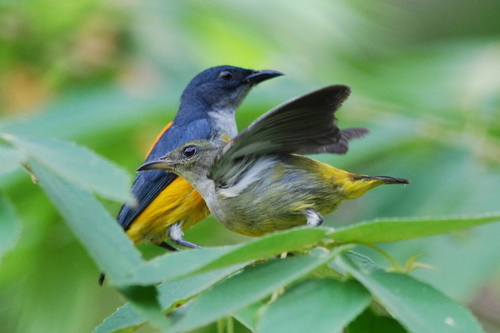
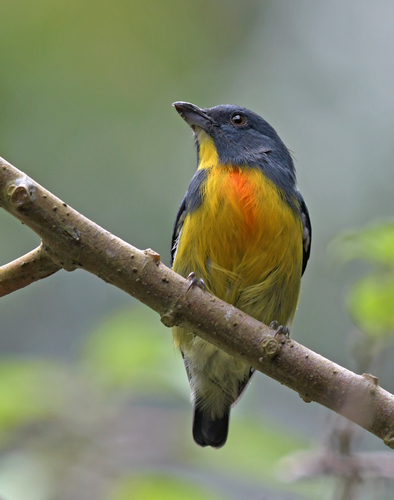
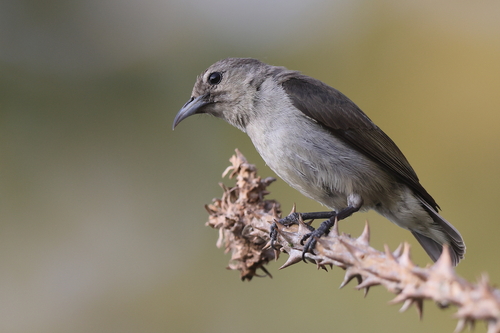
These are tiny birds, 9 cm long, with no marked visible difference between males and females. Currently recognized as a full species by taxonomist Pamela Rasmussen, the taxon originally described as Dicaeum concolor Jerdon, 1840 was previously treated as a subspecies that grouped multiple distinct populations. This species is pale brown on the upper side of the body, and whitish on the underside. The whitish brow in front of the eye is wider than that of Dicaeum erythrorhynchos. It is found in hill forests of the Western Ghats and Nilgiri hills of southern India. Populations that were previously grouped under this taxon are now treated as separate species in modern classification. The population from northeastern India, which ranges into Myanmar, Laos and southern China, was previously called the olivaceum subspecies of Dicaeum concolor, and is now classified as the separate species Dicaeum minullum. This separate species includes the minullum population from Hainan Island, and is now referred to as the plain flowerpecker in the restricted sense. Dicaeum minullum is very olive on the upper body, with a finer, slightly curved black bill. The virescens population from the Andaman Islands, previously grouped as a subspecies of Dicaeum concolor, is also now recognized as the separate species Dicaeum virescens, called the Andaman flowerpecker. This species is bright olive-green on the upper body, with dark speckling on the crown, and a bright pale yellow patch at the center of the belly. Dicaeum concolor, commonly called the Nilgiri flowerpecker, is a common resident breeding bird found in woodland edges, cultivated areas, and isolated stands of trees, most often in hilly terrain. Its call is a sharp check or a rapid series of ticks, while its song is a high-pitched trill. In the Nilgiri hills, the breeding season for this species runs from January to April, with a possible second brood produced in May and June. Females lay two or three eggs in a purse-like nest that is suspended from a tree or bush. Like other flowerpeckers, Nilgiri flowerpeckers have a feathery tongue that lets them sip nectar. They also feed on soft berries and small insects. They act as important pollinators and seed dispersers for mistletoes in tropical forests.