About Dicaeum australe (Hermann, 1783)
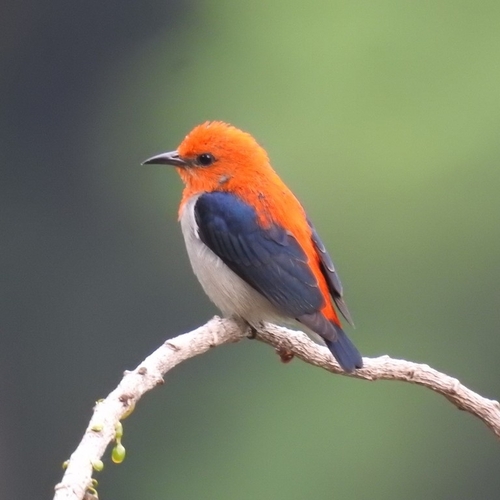
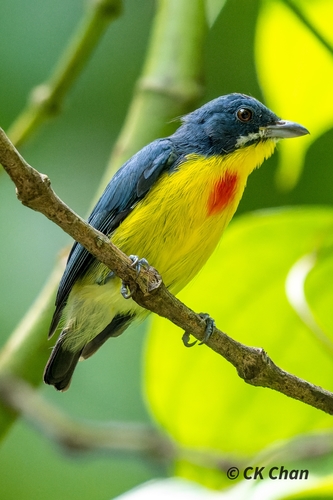
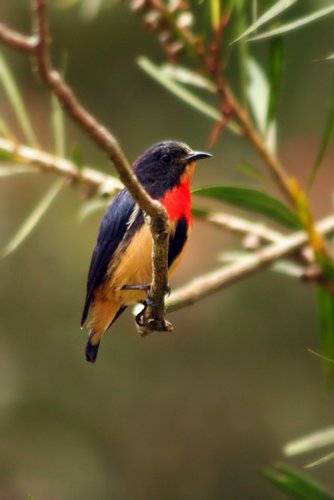
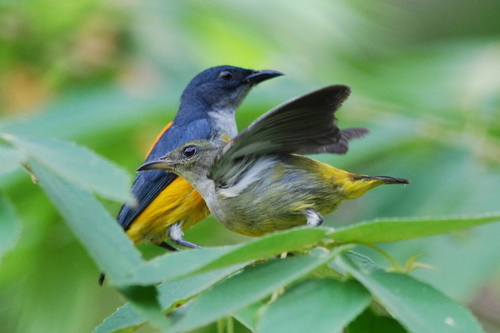
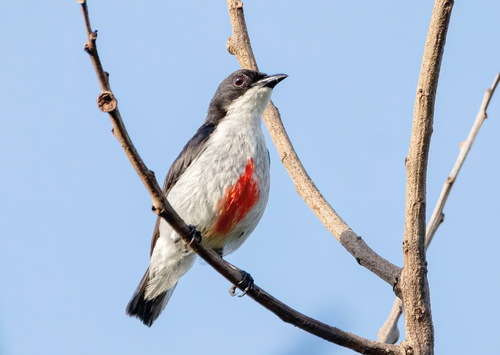
This species is the Red-keeled flowerpecker, with the scientific name Dicaeum australe (Hermann, 1783). It is a small bird with a relatively long, curved bill of medium thickness. The sexes have similar plumage, and recognized subspecies differ in their patterning: the subspecies haematostictum has a black breast and a broad scarlet keel, while the nominate subspecies australe has no black breast and a narrow scarlet keel. For nominate australe males, upperparts are glossy blue-black; the chin and sides of the throat are white. The rest of the underparts are gray, with a diagnostic narrow scarlet stripe running down the center of the breast and belly. Underwings and pectoral tufts are white. Females match the male's pattern but are paler. Immature birds are dark grayish brown on the upperparts, and brownish olive gray on the underparts. The bill and legs are black, and the eye is dark chestnut. The Black-belted flowerpecker was formerly treated as a subspecies of the Red-keeled flowerpecker, but is now classified as a separate species. This Red-keeled flowerpecker is extremely adaptable to almost any habitat except montane forest, and occurs in lowland forest, second growth, agricultural areas, and parks. The IUCN Red List classifies this species as Least Concern, as it is common across its wide range. Its ability to thrive in degraded habitat makes it one of the few endemic Philippine birds that does not have a declining population. The species feeds on small fruits, mistletoes, flowers, and also eats small insects. It forages mostly in the canopy and middle stratum. Individuals can be found alone, in pairs, or in mixed-species flocks alongside other flowerpeckers and other small birds. Breeding activity has been observed from April to August. Despite how common the species is, relatively little is known about its overall biology.