About Diapterus auratus Ranzani, 1842
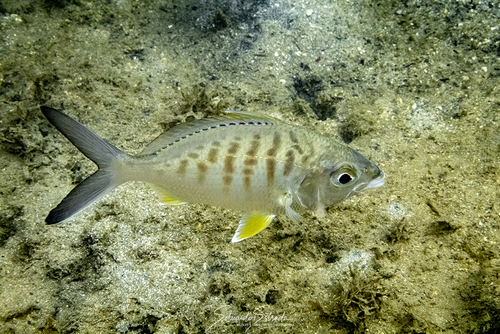
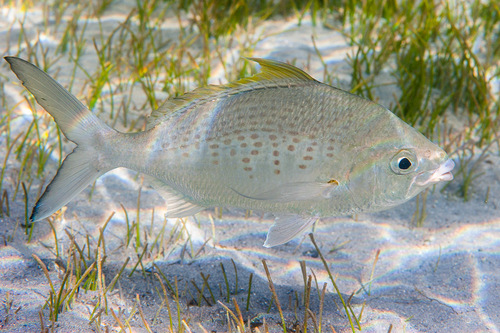
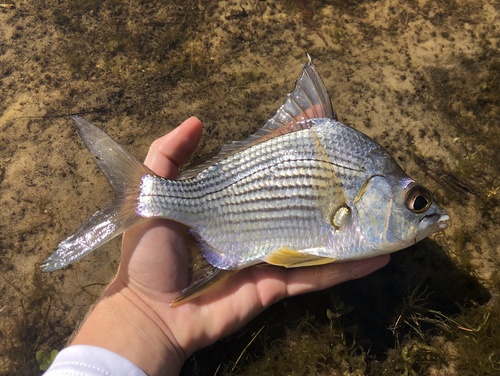
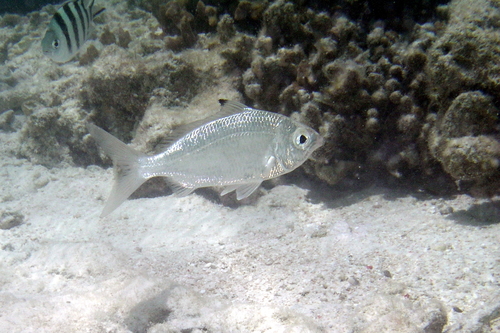
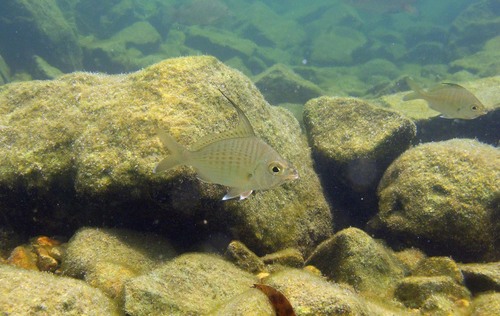
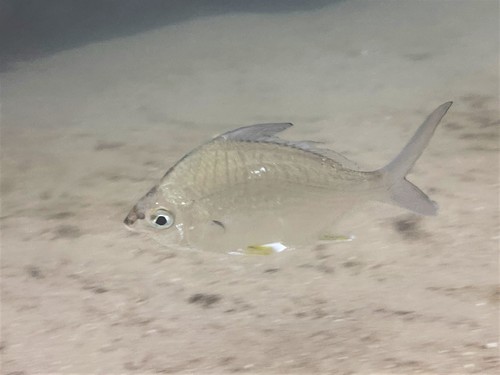
Diapterus auratus, scientifically named Diapterus auratus Ranzani, 1842, has a rhomboidal, compressed body, with a distinctively concave lower profile on its head. It has a highly extensible mouth that points downward when protruded. The jaws hold tiny, brush-like teeth that make the fish appear toothless, and pointed teeth are present inside its throat. Its caudal fin is deeply forked. This species has large, conspicuous scales with a rough texture caused by fine serrations, and these scales cover most of the head and body. The dorsal and anal fins fold into an elevated, scale-covered sheath that runs along the base of these fins. The overall body colour ranges from silvery to olive, and is slightly darker on the upper side; the spiny dorsal fin has a thin black edge. Juveniles have three narrow vertical dark bars. The pelvic and anal fins are yellow, while all other fins are either translucent or dusky. The second spine of the anal fin is longer and thicker than the third anal spine and the anal fin rays. The maximum recorded total length of Diapterus auratus is 34 centimetres (13 in), but a more common total length is 20 centimetres (7.9 in), and the maximum published weight is 680 grams (1.50 lb). This species is found in the western Atlantic Ocean. Its distribution ranges from the southeastern United States, along the Gulf of Mexico coast from western Florida to the Yucatan, through the Caribbean Sea and along the Central American coast, and continues along the northern and eastern coasts of South America to São Paulo, Brazil. Juveniles are more widespread than adults, and the species occurs as a vagrant along the Atlantic coast of the United States as far north as New Jersey. Diapterus auratus is a demersal fish found in shallow coastal waters down to 10 metres (33 ft) depth. It has a strong association with lagoons and vegetated sand grounds, and is also a frequently encountered transient species in mangrove-lined creeks. The largest populations are found in areas with submerged vegetation, and in locations farther from lagoon seawater inlets where salinity is lower. Both adults and juveniles occur in brackish and saltwater lagoons, as well as protected bays. These fish often enter freshwater rivers and streams. The species shows seasonal population fluctuations, and the monthly mean number of sampled individuals correlates with variations in local rainfall and the productivity of lagoon systems. It feeds largely on benthic invertebrates, but also grazes on detritus, algae and cyanobacteria. Smaller fish, with a total length under 11.5 centimetres (4.5 in), feed mainly on plant material, and also eat nematodes, copepods, and ostracods.