About Diaphorina citri Kuwayama, 1908
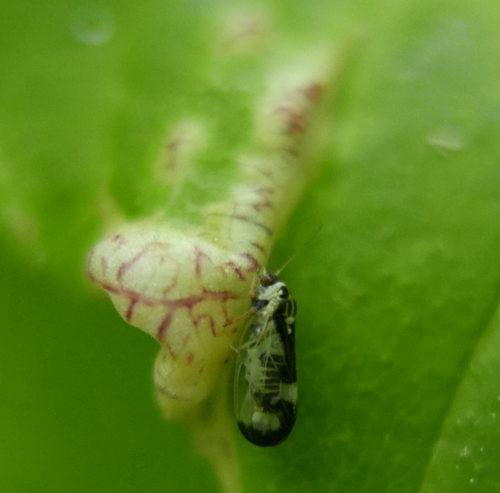
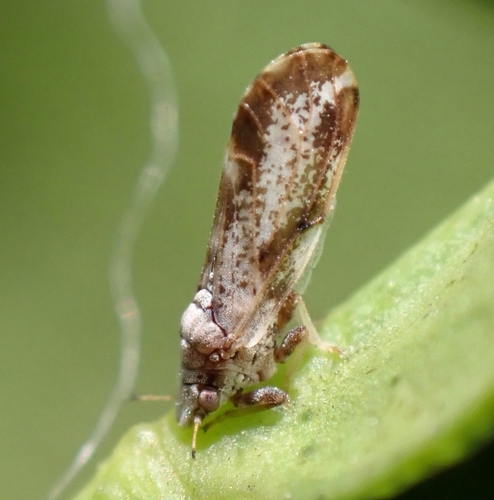
This species, Diaphorina citri, also known as Asian citrus psyllid, can be identified by the following physical and behavioral traits. Adult psyllids are about four millimeters long, with a fawn and brown mottled body and a light brown head. Their bodies are covered in a whitish waxy secretion that gives them a dusty appearance. Their forewings are broadest toward the back, with dark edging along the entire outer edge that leaves a pale gap near the wing apex. Their antennae are pale brown with black tips; these features separate them from the superficially similar African citrus psyllid. While feeding on sap, adults typically hold a posture with their head down and tail up. Psyllids are often found on citrus alongside aphids, but can be easily distinguished from aphids: psyllids are more active jumping insects, while aphids are sedentary. Psyllid antennae have 10 segments, while aphid antennae usually have either four or six segments. Most aphids have cornicles on the abdomen, which psyllids completely lack. Psyllid nymphs molt five times during development. They are yellowish-orange with no abdominal spots, and have prominent wing pads that are especially noticeable in later developmental instars. Eggs are approximately 0.3 millimeters long, almond-shaped, thicker at the base and tapering toward the top. Newly laid eggs are pale in color, then turn yellow and eventually orange just before hatching. The long axis of each egg is positioned vertically relative to the surface of the host leaf. Diaphorina citri originated in Asia, but is now also found in parts of the Middle East, South and Central America, Mexico, and the Caribbean. In the United States, the species was first detected in Florida in 1998, and is now also found in Louisiana, Georgia, Arizona, South Carolina, and Texas. It has been detected in California since 2003. Eradication programs have been implemented in Southern California, the San Joaquin Valley, and Central Coast counties such as San Luis Obispo, to prevent the species from becoming established there. Across the entire United States and its territories, all areas where this psyllid has been found are placed under quarantine restrictions. For their life cycle, females lay eggs on the tips of growing shoots, between and close to unfolding leaves. A female can lay up to 800 eggs over her lifetime, which can last several months. The full development cycle from egg to adult takes between two and seven weeks, depending on temperature and time of year.