About Diaphora mendica (Clerck, 1759)
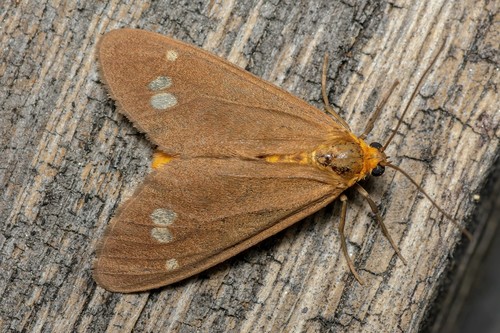
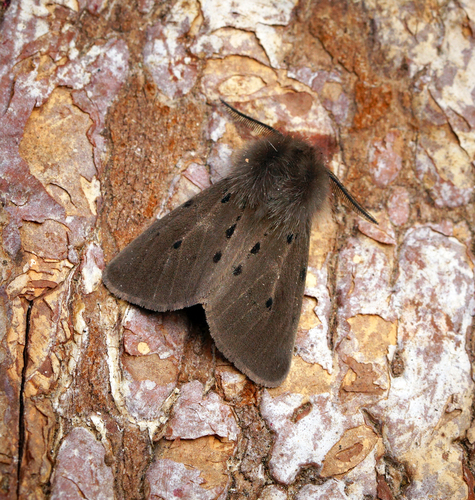
Diaphora mendica (Clerck, 1759) has a wingspan of 28–38 mm, with clear sexual dimorphism in adult moths. Males are brownish grey, with a forewing length of 14–17 mm, and usually have a black dot at the apex of the cell. Some males lack this dot, while others have a few additional accessory dots. Females are white with a forewing length of 17–19 mm; they are thinly scaled, milky white, with abdomens of the same colour, and their wings have very sparse dark dots. Several named aberrations and forms of this species are recognized. Aberration rustica Hbn. refers to males with milky white ground colour matching that of typical females. Aberration binaghii Tur. are transitional specimens between the normal brown D. mendica males and the rustica form. Aberration depuncta, named by Schultz, refers to female specimens that only have one black dot. When white rustica males are paired with normal D. mendica females (this is interbreeding of races, not true hybridisation, contrary to common reports), the resulting peculiar sand-coloured males are called standfussi. When standfussi females are recrossed with rustica males, the offspring are white, heavily dotted moths of the form inversa Car. True hybridisation occurs when rustica males are crossed with other species in the Diaphora genus, such as Diaphora sordida Hbn., producing the true hybrid form f. hybr. viertli Car. This hybrid can be crossed again with other forms: crossing viertli with f. inversa Car. produces hilaris Car., while crossing viertli with D. mendica produces beata Car., among other outcomes. Female Diaphora mendica resemble Spilosoma lubricipeda, but Spilosoma lubricipeda has longer, narrower wings and a yellow and black dorsum.