About Diapheromera femorata (Say, 1824)
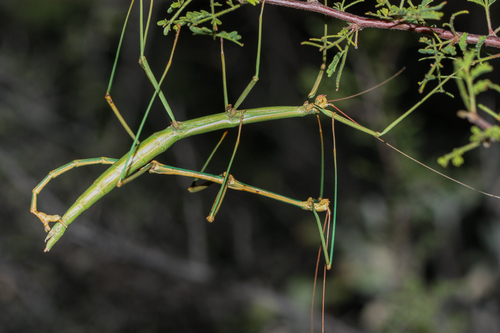
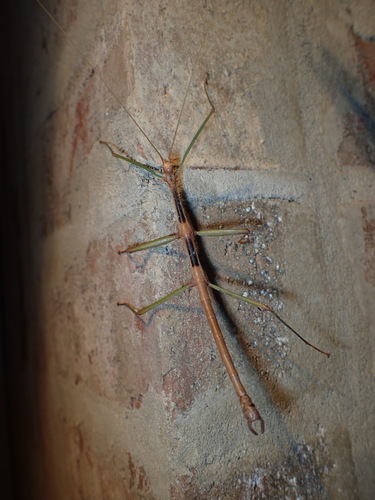
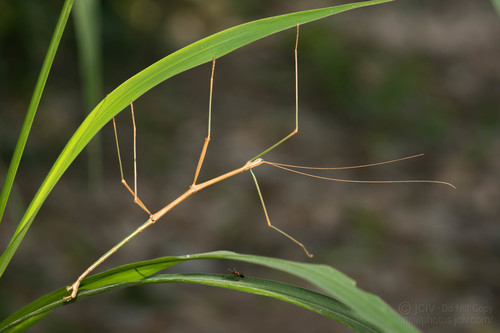
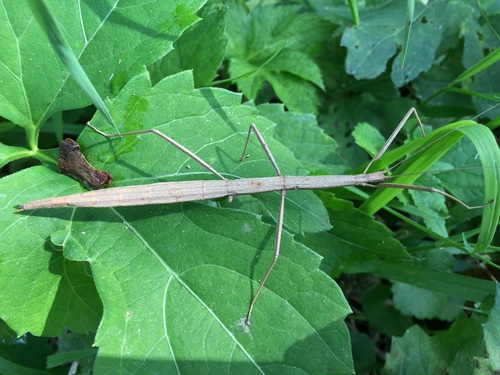
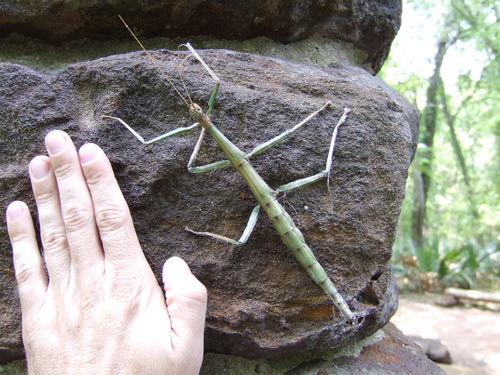
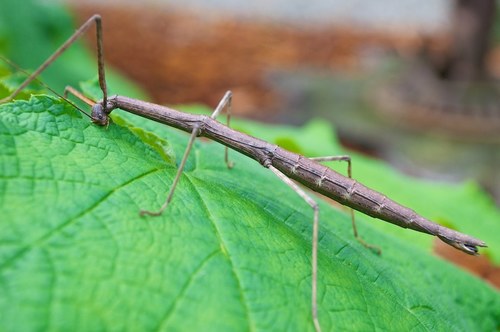
Diapheromera femorata, commonly known as the common walkingstick, is a slender, elongated insect that camouflages itself by resembling a twig. The two sexes differ in appearance: males are usually brown and measure about 75 mm (3 in) long, while females are greenish-brown and larger at 95 mm (3.7 in) long. This species has three pairs of legs, but when at rest, the front pair is extended forward alongside the antennae to enhance the insect's twig-like camouflage. Neither sex has wings, the antennae reach two-thirds of the total body length, and each of the cerci (paired appendages at the tip of the abdomen) has just one segment. The common walkingstick is native to North America. In the United States, its range extends along the Atlantic coast from Maine to Florida, west as far as California, and north to North Dakota. It also lives in Canada, where it is the only native stick insect, and is found in Alberta, Manitoba, Ontario, and Québec. D. femorata is a herbivorous species that feeds mainly on tree leaves. It acts as a leaf skeletoniser, eating the leaf tissue between leaf veins, pausing after feeding, then moving on to new leaves. It can feed at any time of day, but peak feeding activity occurs between 9 pm and 3 am. Early-stage nymphs are most often found on American hazel (Corylus americana) and black cherry (Prunus serotina), but will settle on white oak (Quercus alba) if these preferred species are scarce. Older individuals often feed on black oak (Quercus velutina), and another common host tree is black locust (Robinia pseudoacacia). In the northern part of this species' range, adults are active during August and September. Because they tend to feed high in the tree canopy, these walkingsticks are very seldom seen by people. The common walkingstick has a hemimetabolous life cycle, meaning it develops through a series of nymphal stages instead of a pupal stage. Breeding occurs in late summer, after the final nymphal moult produces a fully grown adult. Egg laying happens around one week after mating. Each egg measures 2.5 mm (0.1 in) across, and eggs are dropped one at a time onto the forest floor. Eggs overwinter in the leaf litter, and hatch the following May, or occasionally one year later. If conditions are dry, newly hatched nymphs often cannot extricate themselves from their egg capsules. Nymphs that do successfully hatch climb up tree trunks to begin feeding on foliage, and grow through four to six moults before reaching adulthood.