About Diapensia lapponica L.
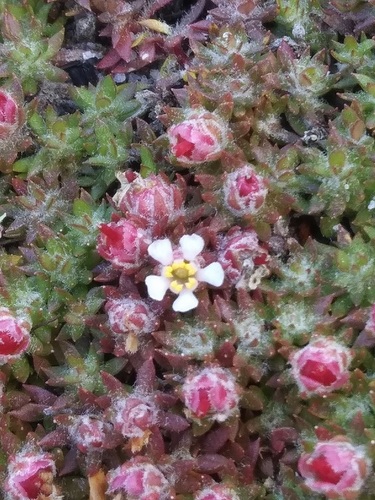
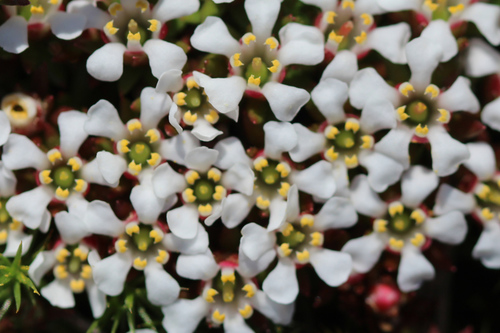
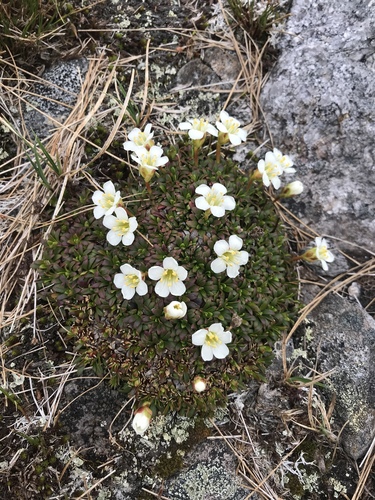
Diapensia lapponica, commonly called the pincushion plant, is a species in the plant family Diapensiaceae. It is the only circumboreal species in the genus Diapensia; most other species of the genus are found mainly in the Himalaya and on mountains in southwestern China. This species likely became a circumboreal-circumpolar Arctic–alpine species after it colonized arctic habitats from North China and Russia, and the most likely candidate for its ancestor is the white-flowered species D. purpurea. Diapensia lapponica grows on exposed rocky ridges that are kept free of snow by high winds. It is an extremely slow-growing, low-growing plant that cannot outcompete plants that grow taller and overtop it. Because it is very sensitive to higher temperatures, it is often found in misty, foggy habitats. Transplants to lowland gardens usually die, so this practice is not recommended. Cold-treated, wild, or winter-collected seed will germinate when grown indoors. The seeds and leaves of Diapensia lapponica are high in lipids. It is a small, cushion-forming evergreen perennial shrub that reaches up to 15 centimetres (6 in) in height, and its dome-shaped growth form can trap heat. It has oval, blunt, leathery, toothless leaves that are up to 1 cm (0.4 in) long, arranged in dense rosettes. It produces solitary white flowers, rarely pink, borne on stems up to 3 cm (1.2 in) tall. Its age can be estimated by counting growth rings or measuring clump diameter, and based on this method, many Canadian individuals of this species are thought to live over 100 to 200 years. In locations like Newfoundland, different individual plants have two distinct blooming periods: early June, and the more frequent August blooming period. It is unknown whether this difference comes from genetic or environmental factors. Two separate blooming periods are recorded for other plant species, and often occur when flower buds are formed in the same year or the previous year, as overwintering buds.