About Dianthus superbus L.
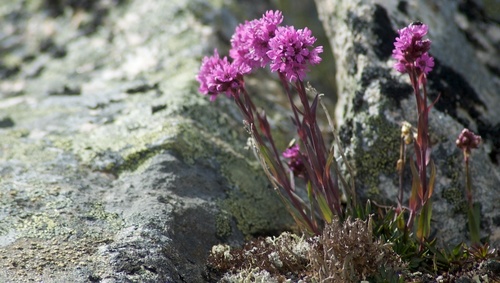
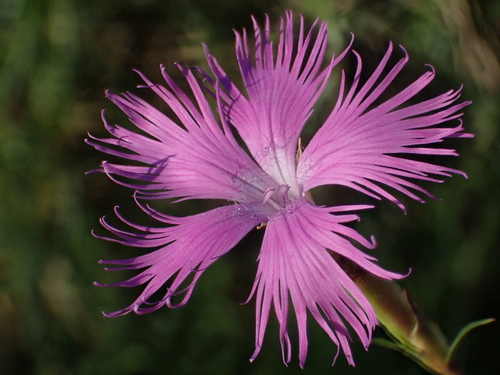
Dianthus superbus, commonly known as fringed pink or large pink, is a Dianthus species native to Europe and northern Asia. Its range extends from France north to arctic Norway, and east to Japan. In the southern part of its range, it grows at high altitudes up to 2,400 m. It is a herbaceous perennial plant that grows up to 80 cm tall. It has slender, green to greyish-green leaves that reach up to 8 cm long. Its sweetly scented flowers are 3–5 cm in diameter, with five deeply cut fringed petals that are pink to lavender with a greenish base. Flowers grow in branched clusters at the tops of stems, blooming from early to late summer. Six subspecies are recognized: Dianthus superbus subsp. superbus, which occurs across most of the species' range; Dianthus superbus subsp. autumnalis Oberd., found in southwestern France; Dianthus superbus subsp. sylvestris Čelak., found in Germany; Dianthus superbus subsp. alpestris Kablík. ex Čelak. (syn. D. s. subsp. speciosus), which grows at high altitudes in the Alps and Carpathians, with shorter stems, greyer leaves, and large flowers; Dianthus superbus subsp. stenocalyx (Trautv. ex Juz.) Kleopow, found in southern Russia and Ukraine; and Dianthus superbus subsp. longicalycinus (Maxim.) Kitam., which grows in Japan, where it is also called nadeshiko (ナデシコ). It is the only known food source for the large moth Coleophora musculella. Dianthus superbus is a popular garden plant, and several cultivars and hybrids have been selected, with flower colors ranging from white to red or purple, usually with a green center. It grows best in ordinary to dry soil in full sun, and prefers partial shade in hot climates. It self-sows freely, and can be propagated by seed, root division, stem layering, or cuttings taken from growing shoots. Removing spent flowers (deadheading) extends its blooming period. In garden cultivation, flowers grow on stems 25–45 cm tall, and the gray-green linear leaves form a low mat at the base of the plant that is 20–30 cm wide. Because the plant grows low to the ground, planting it in groups is recommended for people who want to enjoy its fragrance. Young leaves of Dianthus superbus are edible, and can be eaten after boiling. The flowers produce sweet nectar, and the foliage can be eaten or boiled to make a drink. The plant contains toxic saponins, but in too low a concentration to be harmful. It has historically been used in Chinese herbology as a contraceptive, diuretic, and anti-infective; its Chinese name is qúmài (瞿麦).