About Dianthus chinensis L.
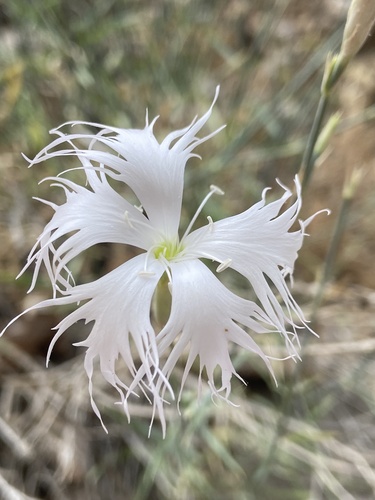
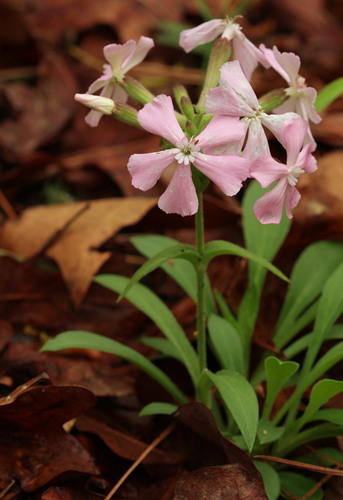
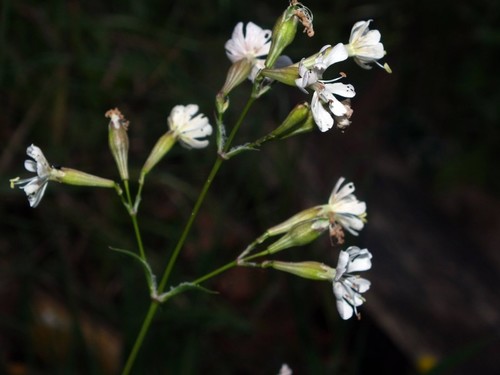
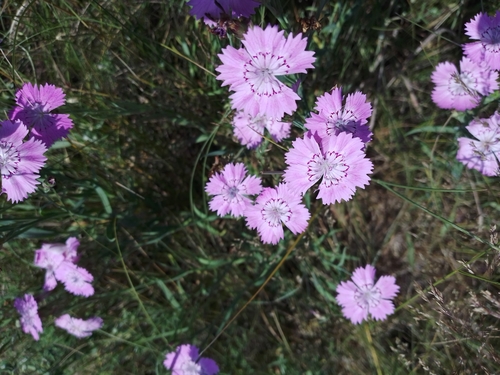
Dianthus chinensis L. has green to greyish-green, slender leaves that measure 3–5 cm long and 2–4 mm broad. It grows as a bush with several branched stems that form a loose clump. Basal leaves are usually already withered when the plant flowers, while leaves persist along the stems. Flowers are white, pink, or red, reach 3–4 cm in diameter, and are produced singly or in small clusters from spring to mid summer. Flowers often occur in pairs in wild plants, and ornamental varieties can bear up to 15 flowers in a cymose inflorescence. Four bracts sit below each flower; these bracts are ciliated, point upward, and extend to half the length of the calyx. The calyx forms a cylindrical tube 1.5 to 2.5 cm long. The corolla is 3 to 4 cm in diameter with serrated edges. Petal color ranges from white to pink to dark red, and the center of the petal is often a darker pigmented shade. The capsule fruit is enclosed by the sepals, and the seeds are black and flattened-roundish. This species has a large natural distribution that includes East Asia: China, Korea, eastern Russia, and extends northwest to Mongolia and Kazakhstan. The Flora of China also lists Europe as part of its distribution area. It grows in grasslands and sparse forests. Dianthus chinensis L. is widely cultivated as an ornamental plant in China and other temperate regions around the world, and numerous cultivars have been selected for garden use. Over time, many forms have been developed through selection and hybridization. Modern breeding efforts focus on creating hybrids with compact bushes, early and long-lasting flowering, and flowers in a wide range of shades. These improved varieties can be grown both by amateur gardeners and for commercial production.