About Dianthus barbatus L.
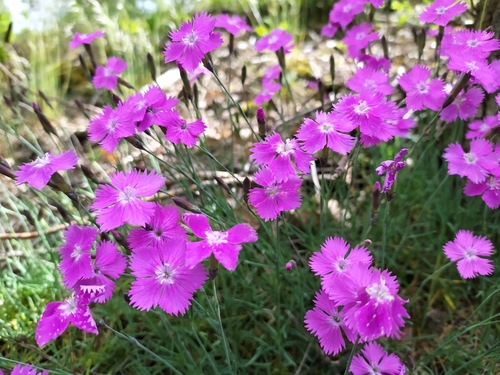
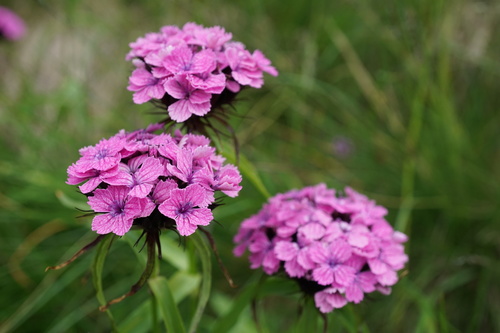
Dianthus barbatus L., commonly called Sweet William, is a species of Dianthus. It grows naturally in the mountains of southern Europe, ranging from the Pyrenees east to the Carpathians and the Balkans, with one disjunct variety found in northeastern China, Korea, and the southeasternmost part of Russia. It reaches a height between 13 and 92 centimeters, a range that varies by variety. Its leaves are tapered, colored from green to glaucous blue-green, measuring 4 to 10 centimeters long and 1 to 2 centimeters broad. Flowers grow in dense clusters of up to 30 at the top of stems, a structure called an umbel, and carry a spicy, clove-like scent. Each flower is 2 to 3 centimeters in diameter, with five petals that have serrated edges. In wild plants, petals are red with a white base. Two varieties are recognized: Dianthus barbatus var. barbatus, native to southern Europe, with broader leaves that grow up to 2 centimeters wide; and Dianthus barbatus var. asiaticus Nakai, native to northeastern Asia, with slenderer leaves that do not grow over 1 centimeter wide. Sweet William is a popular ornamental garden plant, and numerous cultivars and hybrids have been selected for a wide range of flower colors, including white, pink, red, purple, and variegated patterns. It was introduced to northern Europe in the 16th century, and later to North America and other regions, where it has become naturalized from locally to widely. 16th-century botanist John Gerard praised its beauty but did not mention any medicinal uses. Its height makes it well-suited for use in cut flower arrangements. In the Victorian language of flowers, Sweet William symbolizes gallantry. It is widely used in garden borders, rock gardens, and informal country cottage-style gardens. It is a good fit for naturalistic gardens because its nectar attracts birds, bees, and butterflies. Its flowers are considered edible. This plant thrives in loamy, slightly alkaline soil, growing in locations with full sun to partial shade. It can be propagated by seed, cuttings, or division, but seeds from cultivars do not produce offspring that retain the parent cultivar’s traits. If planted from seed after the last frost, it will flower in the second year. If started in growing flats before the last frost and then transplanted outdoors, it may flower in the first year. Many gardeners recommend deadheading spent blooms to encourage additional flowering. The plant is self-seeding. Sweet William is susceptible to Fusarium Wilt, a disease that causes leaves to curl or droop downward. In 1977, researcher Cordell revisited the question of possible medicinal uses for the plant, and found that saponins are present in Sweet William, though there has been little follow-up research on this topic. At the 29 April 2011 wedding of Prince William and Catherine Middleton, Catherine Middleton included Sweet William in her wedding bouquet as a tribute to her bridegroom.