About Dianthera pectoralis (Jacq.) J.F.Gmel.
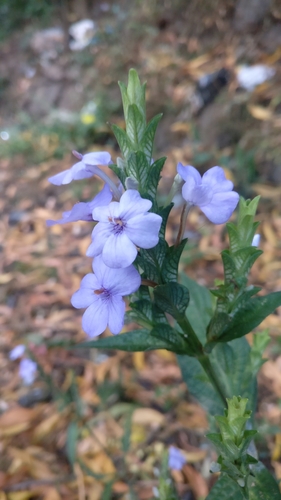
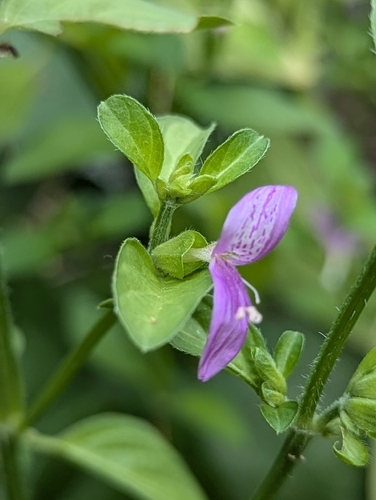
Dianthera pectoralis (Jacq.) J.F.Gmel. is an herb belonging to the Acanthaceae family. Commonly called water-willow, it has many regional common names: it is widely known as tilo across Latin America and Cuba, called chapantye in Haiti, and zeb chapantyè on Dominica and Martinique. Additional folk names for the species include freshcut, chambá carpintero (“carpenter”), té criollo (“Criollo tea”), curia, death-angel, masha-hari, and piri piri.
Nikolaus Joseph von Jacquin first described this species in 1760, and published additional data about it in 1763. A distinct, well-marked variety, Dianthera pectoralis var. stenophylla, was described by Emery Clarence Leonard in 1958.
Throughout the species’ range, it is used in folk medicine as a relaxant and a general tonic. It is also frequently added to prepare ayahuasca, a South American psychoactive brew. Beyond its medicinal uses, Dianthera pectoralis is valued for its pleasant scent, and produces large amounts of coumarin. Many of the plant’s notable properties come from the combination of coumarin and umbelliferone it contains. It is also mixed into epená (Virola) snuff to improve the snuff’s scent.
Var. stenophylla may be hallucinogenic in certain preparations. This variety is known to wajacas (shamans) of Brazil’s Krahô tribe, who call it mashi-hiri and consider it a potent entheogen that should not be consumed by uninitiated people. The Krahô wajacas refer to the leaves of Dianthera pectoralis var. stenophylla as bolek-bena, which translates to “Leaves of the Angel of Death”. The name is thought to originate from the fact that the variety has killed three curanderos.