About Dianthera incerta Brandegee
Dianthera incerta Brandegee is a perennial herb that grows up to 1 meter (3.3 feet) tall. Its young stems are square in shape and may be furrowed. All above-ground plant parts—including foliage, stems, flowers, and fruits—are covered in non-glandular, pubescent hairs. Leaves range from subsessile to petiolate, with petioles growing up to 6 mm (0.24 in) long. After leaves fall, petioles shrink to stubs that measure about 2 mm (0.079 in) along the stem. Leaves are ovate with entire margins, 1.6–5.5 cm (0.63–2.17 in) long and 3.5–4.4 cm (1.4–1.7 in) wide. Leaf tips are acute to acuminate, while leaf bases range from acute to cordate to truncate. This species flowers and fruits from September to December, and again from April to May.
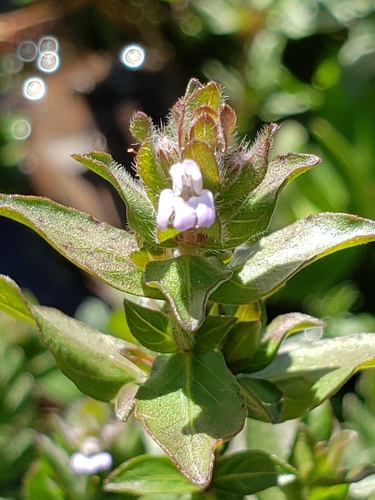
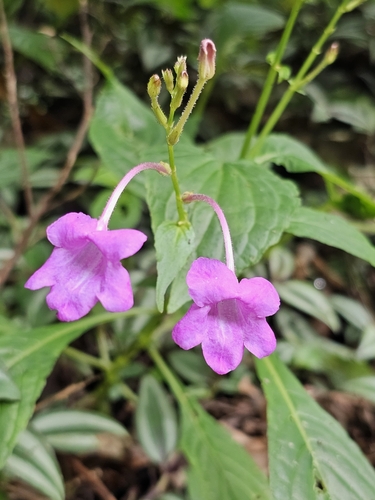
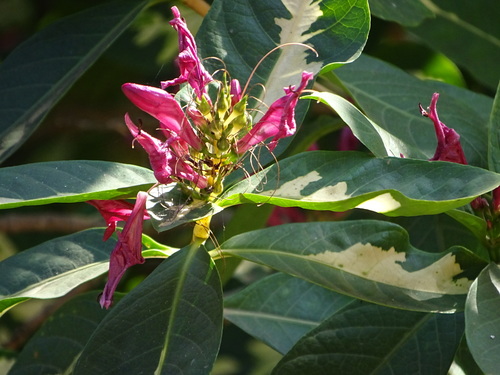
Its inflorescences are dichasia that emerge from leaf axils; distal leaves are sometimes reduced and take on a bract-like form, and inflorescences usually bear only one solitary flower. The dichasia are subsessile to sessile, with a short peduncle that only reaches a maximum length of 1 mm (0.039 in). Sessile bracteoles grow up to 5.5 mm (0.22 in) long. Flowers are sessile, with a 4-lobed calyx 3–7 mm (1.2–2.8 in) long. The two-lipped corolla is rose-pink, marked with a crow's-foot pattern of white and darker pink on the spreading lower lip. The full corolla measures up to 27 mm (1.1 in) long, with a corolla tube 14–17 mm (0.55–0.67 in) long.
The fruit is a capsule 9–13.5 mm (0.35–0.53 in) long, held on a stipe that grows up to 4.5 mm (0.18 in) long. Each capsule contains 4 seeds; individual seeds reach up to 3 mm (0.12 in) long, are white when immature, and turn brown when mature.
Dianthera incerta is endemic to the Cape region of Baja California Sur, the far southern portion of the Baja California peninsula defined by the Sierra de la Laguna and San Lucan scrub. It grows in non-desert mountain and lowland areas of this Cape region, and is typically associated with the region's tropical deciduous forest and pine-oak forest, at elevations between 460 and 1,230 m (1,510 and 4,040 ft). It most often occurs on slopes, along watercourses, and in canyons and gulches.