About Dianella revoluta R.Br.
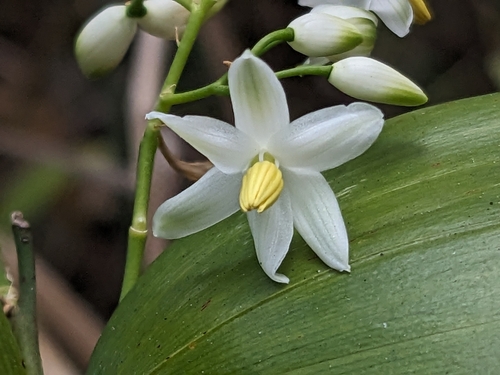
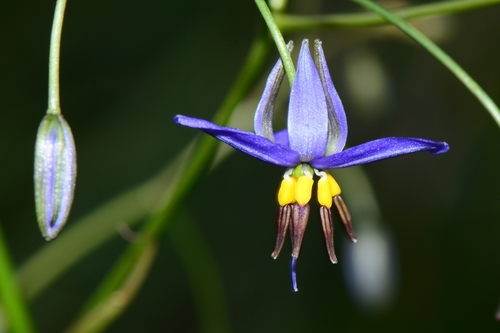
Dianella revoluta R.Br. is a tufted perennial herb. Its stems are less than 15 cm (5.9 in) long, and grow either touching each other or up to 30 cm (12 in) apart. The leaves are folded along their length, grass-like, and measure 15–85 cm (5.9–33.5 in) long by 3–23 mm (0.12–0.91 in) wide. The flowers are blue to violet, arranged in groups of two to nine. Each flower is 10–20 mm (0.39–0.79 in) wide, and grows on a 5–35 mm (0.20–1.38 in) long pedicel. This species has three sepals that are 5.5–10 mm (0.22–0.39 in) long with five to seven veins, and petals that are 5.2–9.5 mm (0.20–0.37 in) long with five veins. The stamen filaments are 0.6–2.3 mm (0.024–0.091 in) long and bright yellow, while the anthers are 2.5–4.5 mm (0.098–0.177 in) long and pale brown to almost black. Flowering occurs mainly from spring to early summer. The fruit is a blue to purple berry that is 4–10 mm (0.16–0.39 in) long. Commonly called blueberry lily, this species is common and widespread across all Australian states and the Australian Capital Territory, but does not occur in the Northern Territory. It grows in a wide range of habitats, excluding very wet and very dry habitats. The berry of D. revoluta is reported to be edible. The town of Dianella, Western Australia was named after this plant, which grew plentifully in the local area before residential development in the 1960s.