About Dianella amoena G.W.Carr & P.F.Horsfall
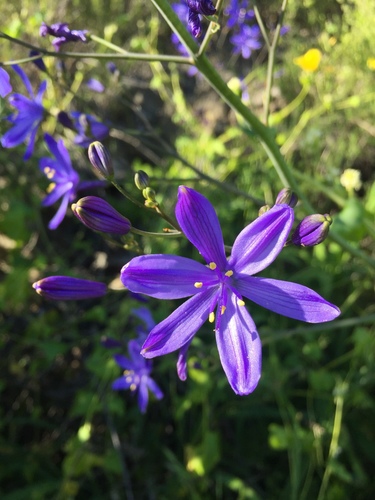
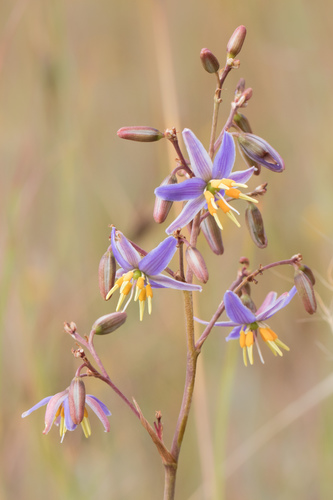
Dianella amoena (scientific name Dianella amoena G.W.Carr & P.F.Horsfall) has slender grey-green leaves with a V-shaped cross section. Most individuals have peg-like projections, or "teeth", along the leaf midrib and margins. This species is clonal: a single plant or colony is made up of multiple genetically identical ramets connected by a rhizome, and it can reproduce both asexually (vegetatively) and sexually. Shoots grow along rhizomes, and can be up to 30 centimetres apart, though they are usually closer together. Its inflorescences stand 20 to 90 centimetres high, growing from a slender scape. The flowers are fragrant, with blue-purple tepals and yellow stamens. After buzz pollination by native bees, these flowers develop into dark blue-purple fruits. When water stressed, the species is partially summer deciduous, but it can flower from October to April when growing conditions are favourable. Dianella amoena grows in grassland and grassy woodland ecosystems, most often on volcanic soils. It has a sparse distribution across south-eastern Australia, occurring mainly in the states of Victoria and Tasmania, with some records extending its range into New South Wales. This species now only grows in small fragmented patches of its original range, found along roadsides, railways, and in urban nature reserves, often in degraded habitats. Scientists believe there is currently no recruitment of new individuals, but the species is long-lived and persists in established remnant clonal patches. Some other species in the Dianella genus have edible fruits, while other Dianella species are considered poisonous. Historically, Aboriginal peoples ate the fruits of some Dianella species, and used Dianella leaves for weaving. No specific information about Dianella amoena's uses is available, because the species was only formally recognised in 1995.