About Diagramma labiosum Macleay, 1883
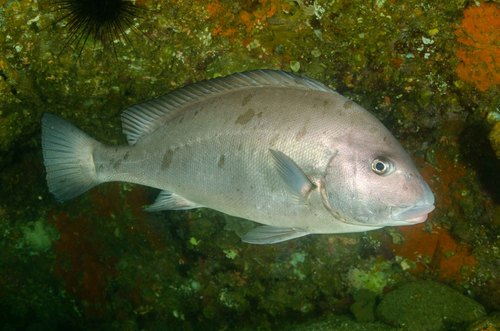
Diagramma labiosum, first formally described by Macleay in 1883, has fleshy lips that grow more swollen as the fish matures. Its chin has six pores, with no median pit. The dorsal fin holds 9 to 10 spines and 22 to 25 soft rays, while the anal fin has 3 spines and 7 soft rays. The species is overall slate-grey in colour; adults and subadults have no body markings, which distinguishes them from the spotted, parapatric painted sweetlips D. pictum. Juvenile D. labiosum have dark brown to black colouring on their dorsal side, split into three or more wide horizontal stripes by narrower whitish-blue stripes, and their ventral side is silvery yellow. The dorsal and caudal fins are yellow with black blotches and discontinuous stripes. These markings expand as the fish ages, fragment into small circular spots, and eventually fade away completely in adult fish. As the fish matures from juvenile to adult, the shape of the caudal fin changes from rounded to truncate. This species reaches a maximum recorded total length of 90 cm (35 in) and a maximum published weight of 6.3 kg (14 lb). Diagramma labiosum occurs in the eastern Indian Ocean and southwestern Pacific Ocean, where its range covers southern New Guinea and northern Australia. In Australia, its distribution extends from the Houtman Abrolhos Islands in Western Australia to Sydney, and includes Lord Howe Island in the Tasman Sea. Diagramma labiosum lives at depths between 10 and 20 m (33 and 66 ft), over soft substrates in seagrass beds, mangroves, and coral reefs. Juveniles are found in estuaries and lagoons. This fish forms large schools, and feeds on crustaceans, molluscs, annelids, cephalopods, and other fishes.