About Diadumene lineata (Verrill, 1869)
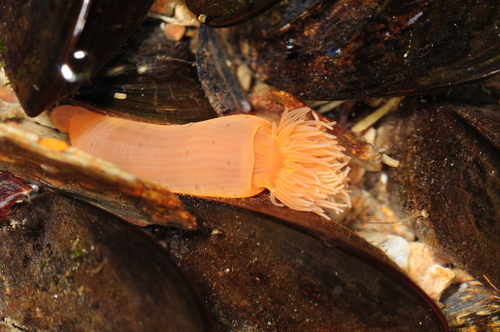
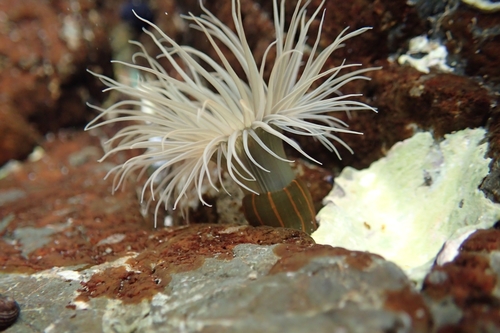
Diadumene lineata is a small sea anemone species. When fully extended, it reaches approximately 3 centimeters in height and around 3.5 centimeters in diameter across its tentacles. Its smooth central column ranges in color from green-gray to brown, and stretches from the mouth down to the pedal disc, the attached base that anchors the anemone. The column does not always have vertical stripes; when present, these stripes may be orange or white. This species has between 50 and 100 slender, tapered tentacles that can retract completely into the column. The tentacles are most commonly transparent, and may be gray or light green with white flecks (Christine 2001). Multiple taxonomic morphs and synonyms have been recorded for this species, including Sagartia lineata (Verill, 1869, Hong Kong), Diadumene lineata (Verill 1870), Diaumene luciae (Stephenson, 1925), and Haliplanella luciae (Hand, 1955). The currently accepted correct name is D. lineata (Hand 1989). A single population of this species may contain one or more functional morphological variants (Hand, 1955b; Williams, 1973b). Population studies examining morphs across multiple different communities have been conducted, with input from personal communications from Parker (1919), Allee (1923), and Stephenson (1935). D.F. Dunn discovered an un-striped population of this species in San Francisco Bay, California. Two distinct morphs were recorded in other studies: one with twelve orange stripes on a green-brown column, and another with 48 paired white stripes on a green column. These population studies were carried out at Indian Field Creek, Virginia and Barnstable Town Dock, Massachusetts by C.P. Mangum. This species is native to the Pacific coast of Asia, and is now widespread across the Northern Hemisphere. It has been recorded in Japan, the Gulf of Mexico, Plymouth and Wells (Norfolk, England), Western Europe, the Mediterranean Sea, the Suez Canal, Malaysia, the east and west coasts of North America, Hawaii, and other sites across the Pacific Ocean. It has recently also been found in Argentina and other localities in South America. Its spread outside of Asia is thought to have happened through attachment to ship hulls, oyster shipments, and seaweed. These anemones colonize ecosystems that are barren or have low species diversity. They often appear suddenly, with populations growing and proliferating quickly to colonize new areas, which can alter local ecological balances. Populations are also known to disappear from an area quickly and without warning (Stephenson 1953). This species is a member of fouling communities, but it does not cause significant economic harm. While Diadumene lineata is capable of sexual reproduction, it normally reproduces asexually via longitudinal fission, a process where the original anemone splits in half, and a new polyp develops from the separated portion of the original polyp. In many locations, there is little to no genetic variation between individual polyps, as all individuals are genetic clones of a single original colonist. This lack of genetic diversity explains why apparently thriving populations can suddenly disappear: when environmental conditions reach the tolerance limit of the clone, the entire population experiences sudden mortality.