About Diadema setosum (Leske, 1778)
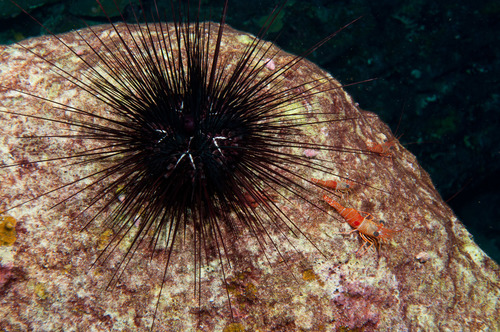
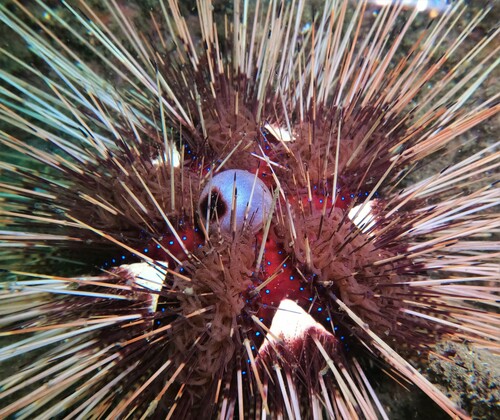
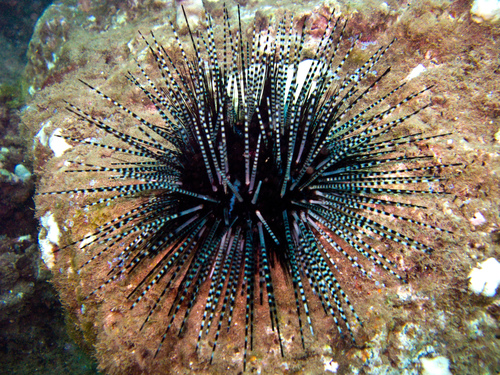
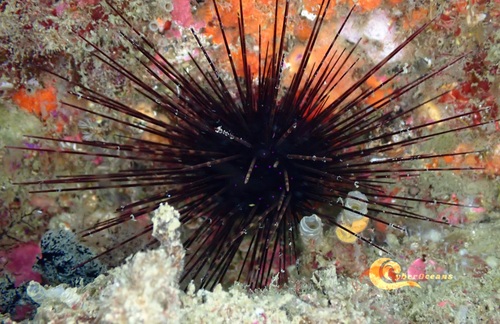
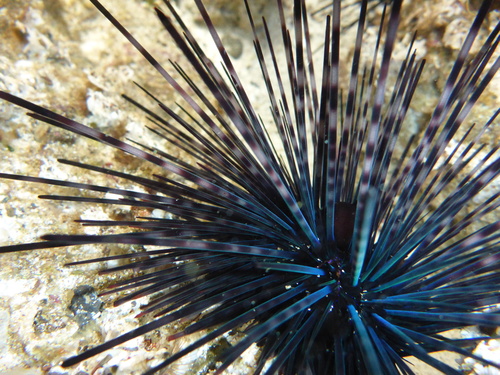
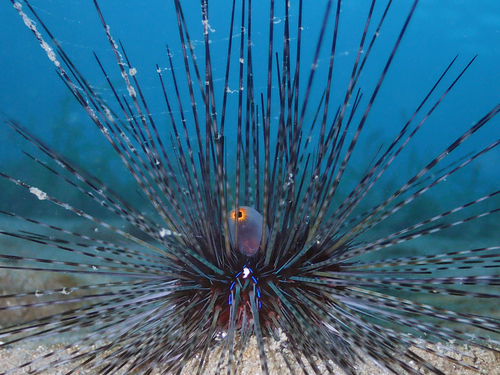
Diadema setosum (Leske, 1778) is a species of sea urchin belonging to class Echinoidea, with anatomy typical of other sea urchins. All of its internal organs are enclosed within a near-spherical black test, which acts as both the organism's body and skeleton. Its test is not perfectly spherical, instead being slightly flattened along the dorso-ventral axis. Long spines, the iconic feature of sea urchins, protrude outward from its central body. As a member of the family Diadematidae, its spines are extremely long and narrow relative to the size of its body. The spines are usually black, sometimes marked with brown bands, and are hollow with mild venom inside. D. setosum can be told apart from other species in the genus Diadema by five white spots on its test, positioned between the urchin's ambulacral grooves. An additional clear distinguishing trait is a bright orange ring surrounding the urchin's periproctal cone, also called the anal cone, which is often misidentified as an eye. Minor distinguishing characteristics include bluish spots on the species' genital plates, and similar blue spots called iridophores arranged in lines along its test. This species lacks an apical ring, and also lacks calcareous platelets on its apical cone. Sexually mature D. setosum specimens average 35 to 80 grams (1.2 to 2.8 oz) in weight. Adult tests average no more than 70 millimeters (2.8 in) in diameter, and the urchins average around 40 millimeters (1.6 in) in height. This is a widely distributed sea urchin species, with a natural range covering the entire Indo-Pacific basin including Malaysia. Longitudinally, its range extends from the Red Sea eastward to the Australian coast. Latitudinally, it can be found as far north as Japan, and its natural range reaches as far south as the southern tip of Africa's east coast. The species has been introduced to areas outside its natural range. In 2006, two living specimens were found in waters off the Kaş peninsula in Turkey. This discovery makes D. setosum the first invasive Erythrean sea urchin recorded in the Mediterranean. Three main hypotheses explain how the species reached this area. Larvae may have moved through the Suez Canal into the Mediterranean via Lessepsian migration from the Gulf of Suez, where the species has a healthy natural population. Another possible vector is transport by foreign ships in ship ballast. The final proposed possibility is that the specimens were intentionally released by aquarists. D. setosum is most commonly associated with coral reefs, but it also lives on sand flats and in seagrass beds. Like other members of its family, D. setosum is a highly active grazer, and feeds on a variety of algal species common on tropical coral reefs. The whole taxon is noted for its ecological importance due to these herbivorous feeding habits. In Hong Kong, D. setosum is found everywhere on rocky reefs, reaching population densities of up to one individual per 3.4 square meters. Researchers theorize this unusually large population is partially natural, and partially caused by overfishing of the urchin's main local predator, the blackspot tuskfish Choerodon schoenleinii.